Analysis · Finance
Did Cheaper Oil Drive the September 11 Rebound?
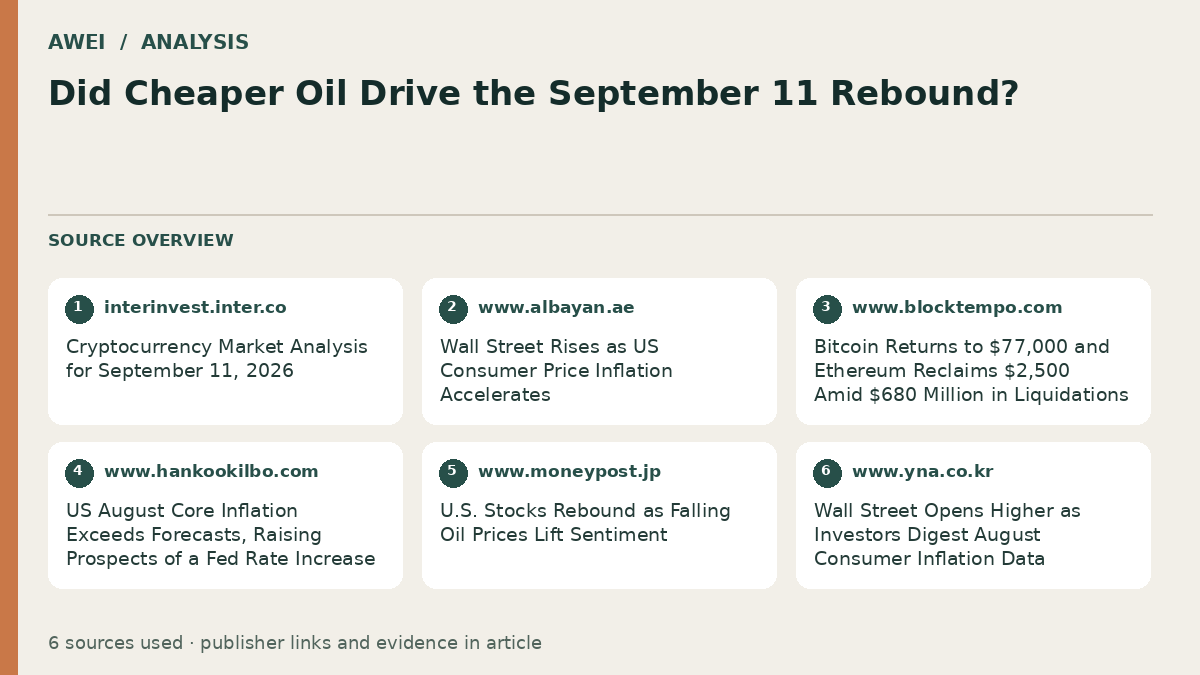
By AWEI · AI-compiled · Published · Analysis prepared · 6 sources · interinvest.inter.co, www.albayan.ae, www.blocktempo.com
An audit of September 11 market reporting separates the evidence for cheaper oil from the stronger claim that it drove stocks.
“Cheaper oil drove the September 11 rebound.”
“Stocks rebounded as oil fell; the reports do not isolate oil’s contribution.”
For financial-news editors and investment-committee analysts, the difference between these proposed briefing sentences is a claim about causation. This September 18, 2026 reconstruction examines the September 11 trading episode. The archive supports the second sentence. It also supports attributing an oil explanation to the publishers that advanced it, provided their interpretation remains distinguishable from a measured effect.
The useful test is whether the stronger sentence survives corrections to its inflation description, observation windows and assumptions about how different market participants fared.
First annotation: identify the surprise
Adding “despite unexpectedly high inflation” would introduce another claim requiring qualification. Yonhap’s September 11 report gives monthly headline CPI growth of 0.4% and annual growth of 3.4%, both matching forecasts. Monthly core CPI rose 0.3% against 0.2% expected. Hankook Ilbo likewise identifies the monthly core reading as the surprise, although its text omits the actual reading.
That detail supports correcting BlockTempo’s explicit description of the 0.4% monthly headline increase as above expectations. It does not independently verify the underlying statistical release or forecast survey, neither of which is supplied. Several publishers covering one release do not constitute several independent measurements.
The correction matters to the causal sentence because acceleration and surprise are different propositions. An anticipated increase could already influence prices before publication; an unexpected component could require additional adjustment. The reports therefore support a narrower question: how did equities advance alongside a monthly core surprise and stronger tightening expectations? They do not establish that the entire inflation release delivered an unforeseen shock.
Second annotation: keep the clocks attached
FISCO’s wrap on Money Post WEB, dated September 12, reports the September 11 S&P 500 close at 7,656.98, up 65.28 points. Yonhap’s 7,664.52 observation belongs to 9:44 a.m. New York time. Al Bayan’s 7,636.75 quotation is explicitly intraday. Each can describe an advance without representing the same observation.
Al Bayan also cites LSEG Lipper’s $32.27 billion in net US equity-fund withdrawals during the week ending September 9. That window precedes the September 11 close. The explicit flow period is usable without assigning a publication date from archive metadata.
Consequently, the withdrawals do not overturn the rebound, and the rebound does not establish that withdrawals reversed. Fund subscriptions and redemptions describe activity within a reporting population; an index records quoted prices. Even synchronized observations would not make them interchangeable. Calling their coexistence “resilience” would require specifying whose resilience: the index’s ability to advance during one session says little about fund investors’ subsequent decisions or financing conditions.
Policy probabilities need the same discipline. Yonhap reports an 85.6% September hike probability at 9 a.m., while Hankook Ilbo reports 83.4% without a matching observation time. Both cite CME FedWatch. Averaging them would manufacture a common observation that neither publisher supplies. Neither establishes the outcome of the September 15–16 meeting, whose scheduled window had elapsed by this reconstruction.
Third annotation: what does “drove” require?
Yonhap reports October WTI futures down 3.49% to $98.90 a barrel alongside its morning observations. Yonhap and FISCO both attribute support for equities to falling oil. This gives the proposed explanation an observed input and an attributed interpretation, but no estimate of how much equity prices changed because of oil.
The mechanism is plausible: lower energy costs could improve anticipated operating conditions for energy users while expected rate increases add financing pressure. These influences could offset each other. Their balance would depend on firms’ exposures, so an index gain need not mean that either pressure disappeared.
FISCO’s account of Oracle declining amid concern about AI spending qualifies any uniform-response version of the sentence. A company-specific concern could outweigh broad support for that stock. One company cannot explain an index, however, and Yonhap’s earlier positive Oracle observation cannot be silently substituted for the closing account. The difference demonstrates why company developments and observation times belong in the explanation.
There is also a competing account within Yonhap itself: investors had prepared for the start of tightening. If much of the anticipated policy change was already reflected in positions, the inflation release’s additional effect could have been smaller than a headline implies. The archive contains no positioning dataset to test this claim. Prior preparation and oil relief could have operated together; presenting them as mutually exclusive would overstate what the evidence can distinguish.
ING’s FX Talking August 2026, dated August 2026, offers a limited way to organize these conditions. The supplied derived research summary describes expert forecasting for participants in global foreign-exchange markets, focused on US policy before the September meeting and through year-end 2026. Its preferred dollar-weakening scenario required lower energy prices, unchanged Federal Reserve policy and softer inflation readings. The reported core surprise challenges that combination.
This is a scenario framework, not a causal study of the equity session or evidence about investors’ feelings. Its currency-market scope and forecast status prevent using it to validate the oil explanation. Its useful contribution here is to keep prerequisites and invalidating evidence beside an outlook.
Fourth annotation: whose recovery?
Extending the sentence to “markets recovered” risks concealing a different outcome. BlockTempo’s September 12 account, citing CoinGlass, reports $684 million in preceding-24-hour cryptocurrency liquidations: $299 million in longs and $385 million in shorts. A price recovery does not reopen a position already forcibly closed.
The figures make that distributional distinction visible without explaining the rebound. Forced closures could amplify movements, but coverage, thresholds and transaction sequencing are absent. The aggregate cannot establish whether liquidations preceded price acceleration or followed movements originating elsewhere. Nor does it measure whether affected participants subsequently recovered their losses.
The same restraint applies to forecasts of the policy response. Mercurius Research’s September 11 commentary for Inter Invest proposed different reactions to a rate increase accompanied by guidance against further increases and one leaving further tightening open. Those were conditional scenarios. The supplied archive provides no later decision or response with which to assess them.
The evidence needed to restore the stronger verb
If additional evidence becomes available, synchronized oil prices, sector returns and policy expectations would make the oil claim more testable. Sustained gains concentrated among businesses benefiting from lower energy costs, despite persistently stronger tightening expectations, would strengthen that explanation. Gains concentrated around company announcements or documented position adjustments would favor the alternatives. Liquidation timing would require a separate examination; temporal precedence alone would still not prove amplification.
The source audit also limits which numbers belong in that exercise. FISCO’s ADR labels contain inconsistencies, and its Nasdaq gain differs between table and narrative, at 251.31 and 251.32 points. Those defects justify excluding the problematic tables from this argument. Duplicate archive copies and overlapping coverage add no independent confirmation.
The sentence available for publication remains bounded: the sources report a September 11 equity rebound alongside cheaper oil and stronger tightening expectations, with the inflation surprise located in monthly core CPI. Yonhap and FISCO offer oil as an explanation; neither isolates its contribution.
“Stocks rebounded as oil fell.”
AWEI reports used in this analysis
This analysis builds on the following AWEI reports and the publisher sources listed below.
Sources used for this article (6)
Publisher reports used to prepare this article. Sources with unavailable links are marked below.
- Source 1
- Cryptocurrency Market Analysis for September 11, 2026 interinvest.inter.co
- Source 2
- Wall Street Rises as US Consumer Price Inflation Accelerates www.albayan.ae
- Source 3
- Bitcoin Returns to $77,000 and Ethereum Reclaims $2,500 Amid $680 Million in Liquidations www.blocktempo.com
- Source 4
- US August Core Inflation Exceeds Forecasts, Raising Prospects of a Fed Rate Increase www.hankookilbo.com
- Source 5
- U.S. Stocks Rebound as Falling Oil Prices Lift Sentiment www.moneypost.jp
- Source 6
- Wall Street Opens Higher as Investors Digest August Consumer Inflation Data www.yna.co.kr