Analysis · Finance
September 11 Markets: Label the Measure and the Time
By AWEI · AI-compiled · Published · Analysis prepared · 6 sources · www.albayan.ae, www.blocktempo.com, www.forecastock.tw
Separating headline from core inflation and prices from earlier fund flows clarifies September 11, without proving why stocks rose.
The September 11, 2026 market story becomes clearer with two labels attached to every number: which measure, and which observation time. Yonhap reported August headline consumer inflation of 0.4% monthly, matching forecasts, and monthly core inflation of 0.3%, above a 0.2% forecast. It placed the S&P 500 at 7,664.52 at 9:44 a.m. New York time. FISCO's account on Money Post WEB gave the session's close as 7,656.98. A mixed inflation release and higher share prices can coexist; the remaining question is what explains the advance.
For financial-news readers and editors, this reconstruction does more than tidy the chronology. It identifies a correctable description of the inflation surprise while separating that correction from the much harder task of establishing market causation.
Which inflation measure surprised?
| Measure | Reported August reading | Comparison with forecasts |
|---|---|---|
| Headline CPI, monthly | 0.4% | Matched, according to Yonhap |
| Headline CPI, annual | 3.4% | Matched, according to Yonhap |
| Core CPI, monthly | 0.3% | Above 0.2%, according to Yonhap |
| Core CPI, annual | 2.4% | Matched, according to Yonhap |
Hankook Ilbo also describes the headline readings as matching forecasts and monthly core inflation as exceeding expectations, although it omits the actual monthly core reading. These detailed accounts permit a qualified reconciliation of two compressed descriptions elsewhere in the archive. BlockTempo explicitly calls the 0.4% monthly headline reading above expectations. CMoney's brief on Forecastock broadly calls the inflation report in line with expectations. The detailed evidence supports expected headline inflation alongside an upward monthly core surprise.
This resolves a wording problem without independently verifying the release or forecast survey. The publishers are describing the same underlying economic release; their agreement is not a set of independent measurements. Nevertheless, the detail matters: “inflation exceeded expectations” loses the distinction between a reported surprise in one component and forecast matches in others.
It also changes the causal question. The occurrence of an inflation increase and the arrival of unexpected inflation information are different propositions. A narrative about repricing needs to establish what was already anticipated before explaining what changed afterward. The archive helps identify the reported surprise, but cannot measure its isolated contribution to equity prices.
Which observation belongs to which clock?
| Observation window | Attributed observation | What it describes |
|---|---|---|
| Week ending September 9 | Al Bayan, citing LSEG Lipper: $32.27 billion in net US equity-fund withdrawals | Fund subscriptions and redemptions over a week |
| September 11, 9 a.m. | Yonhap, citing CME FedWatch: 85.6% September hike probability | A timestamped policy expectation |
| September 11, 9:44 a.m. | Yonhap: S&P 500 at 7,664.52 | An early-session index level |
| September 11 close | FISCO: S&P 500 at 7,656.98, up 65.28 points | The session's closing result |
Al Bayan's separate intraday S&P 500 quotation of 7,636.75 belongs to another observation within trading, rather than a competing closing figure. Hankook Ilbo reports an 83.4% hike probability, but provides no matching observation time with which to reconcile it precisely with Yonhap's 9 a.m. figure. Averaging the probabilities would discard the distinction rather than resolve it.
Earlier fund withdrawals cannot be reversed retrospectively by a later index gain. More fundamentally, prices and fund flows remain different measures even when their windows match. An index level records quoted prices; fund flows record activity within a specified reporting population. Their apparent disagreement is therefore insufficient evidence of inconsistent market behavior.
FISCO's tables also require selective use: the Nasdaq gain differs by one-hundredth of a point between table and prose, and ADR company labels are inconsistent. Those defects warrant avoiding unnecessary table reuse. They should not be explained away as changes during trading.
What might explain the rebound?
Yonhap and FISCO attribute support to falling oil, while Yonhap also advances a prior-positioning explanation. Yonhap reports October WTI futures down 3.49% at $98.90 per barrel alongside its morning market observations. A plausible mechanism is that lower oil reduces expected costs for energy users while anticipated tightening increases financing pressure. Those effects could pull in different directions across firms; the reports do not quantify their distribution or establish which dominated.
Company developments offer another explanation for parts of the session. Yonhap describes Oracle rising early after earnings, while FISCO reports a later decline amid concern about AI spending. This sequence warns against extending an opening company reaction into a full-day account. One company's catalyst also cannot establish the reason an entire index advanced.
ING's FX Talking August 2026, dated August 2026, supplies a limited scenario lens: keep an outlook's prerequisites and invalidation conditions visible. This is expert forecasting for participants in global foreign-exchange markets, focused on US policy ahead of September 16 and through year-end 2026. It is neither a causal study of this equity session nor research into investor psychology. Its preferred scenario required lower energy prices, unchanged Fed policy and softer inflation readings. The reported monthly core surprise challenges those conditions; it does not validate the preferred outlook. The supplied research summary offers a way to organize alternatives, without independently confirming market facts or forecast accuracy.
Crypto data leave a further sequencing problem. BlockTempo, citing CoinGlass, reports $684 million in liquidations over 24 hours: $299 million in longs and $385 million in shorts. These totals establish reported forced closures on both sides, but lack individual thresholds, detailed coverage and the event timing needed to distinguish amplification of price reversals from liquidations following them. They cannot establish that forced closures caused the rebound.
Consistently timed evidence could narrow these alternatives. A sustained broad advance alongside lower oil despite persistently higher rate expectations would strengthen an oil-offset interpretation. Gains concentrated around specific company catalysts would favor a narrower explanation. Liquidation bursts preceding price acceleration would be more consistent with amplification than aggregates observed afterward, though timing alone would not prove causation.
The archive thus supports a specific correction and a bounded reconstruction: headline inflation reportedly matched forecasts, monthly core inflation exceeded them, and equities closed higher. It does not identify one cause or establish the subsequent September 15–16 Federal Reserve decision. Reaching September 16 on the analysis calendar supplies no evidence of that outcome.
AWEI reports used in this analysis
This analysis builds on the following AWEI reports and the publisher sources listed below.
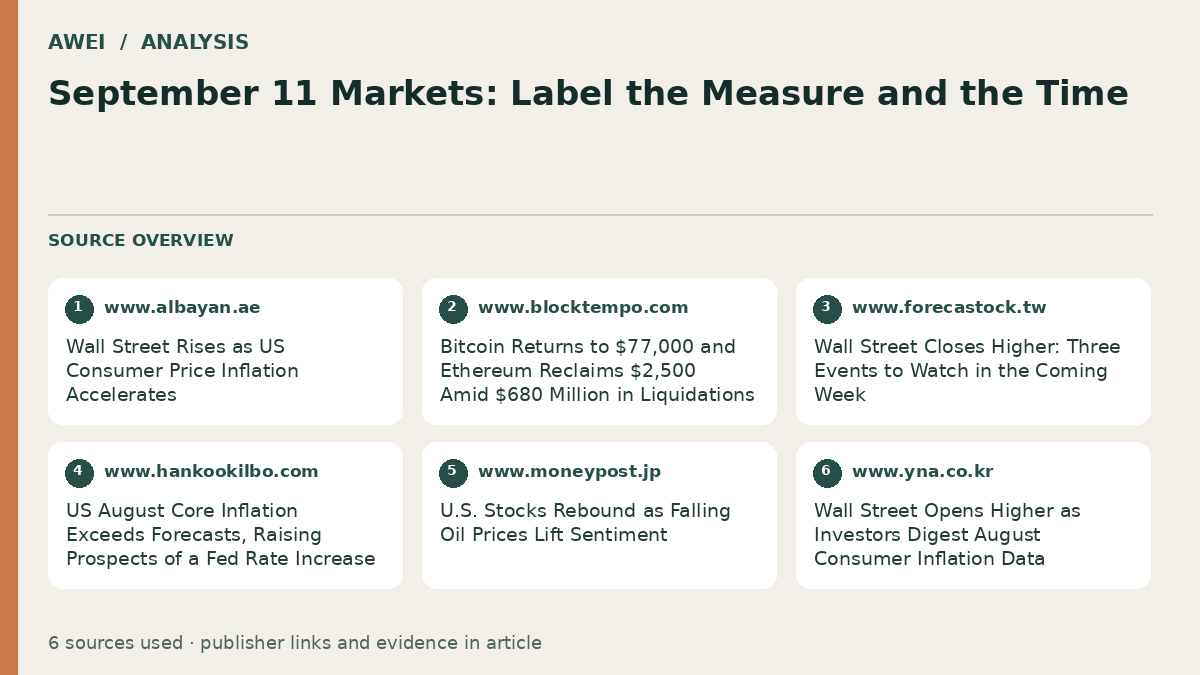
Sources used for this article (6)
Publisher reports used to prepare this article. Sources with unavailable links are marked below.
- Source 1
- Wall Street Rises as US Consumer Price Inflation Accelerates www.albayan.ae
- Source 2
- Bitcoin Returns to $77,000 and Ethereum Reclaims $2,500 Amid $680 Million in Liquidations www.blocktempo.com
- Source 3
- Wall Street Closes Higher: Three Events to Watch in the Coming Week www.forecastock.tw
- Source 4
- US August Core Inflation Exceeds Forecasts, Raising Prospects of a Fed Rate Increase www.hankookilbo.com
- Source 5
- U.S. Stocks Rebound as Falling Oil Prices Lift Sentiment www.moneypost.jp
- Source 6
- Wall Street Opens Higher as Investors Digest August Consumer Inflation Data www.yna.co.kr