News · Finance
Why September Markets Run on Three Different Clocks
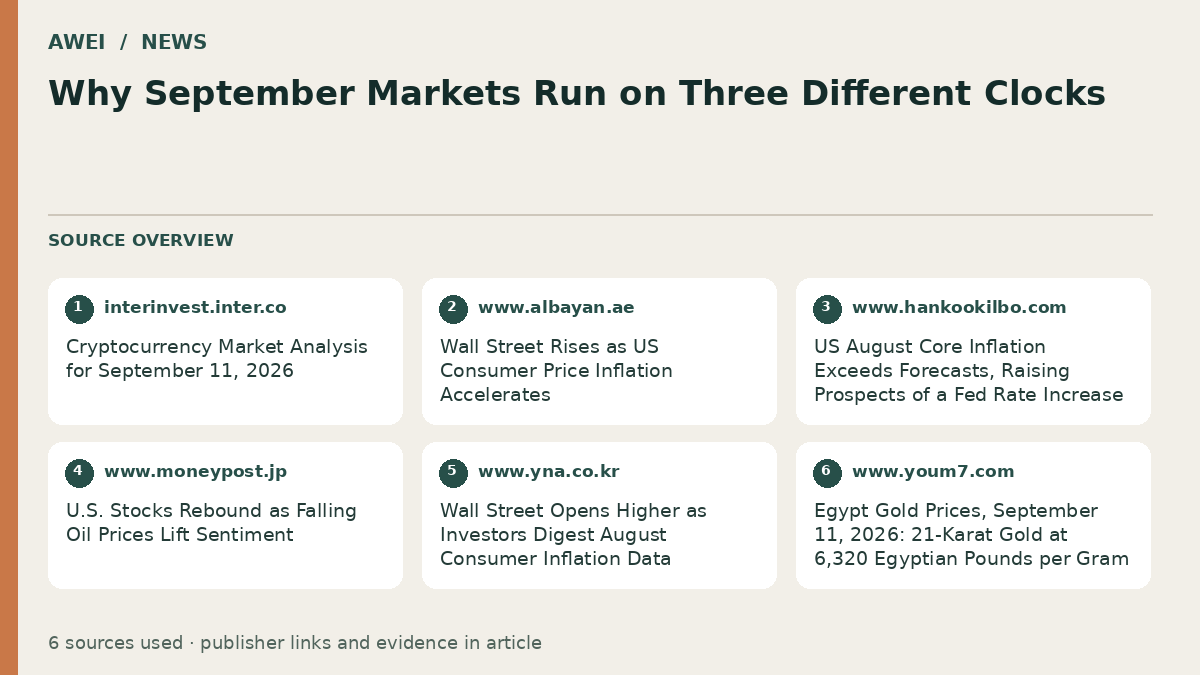
By AWEI · AI-compiled · Published · 6 sources · interinvest.inter.co, www.albayan.ae, www.hankookilbo.com
Stocks, gold and Bitcoin tell different September stories. Matching their timelines helps explain apparent market contradictions.
For investors comparing September returns, a rising stock index and heavy fund withdrawals can suggest contradictory signals. Yet September 11 share prices cannot reverse money withdrawn during the week ending September 9. These markets run on three different clocks: the moment a price is observed, the period an economic measure covers, and the future being anticipated. Keeping those clocks separate explains why apparently conflicting reports can coexist, although it cannot establish what caused the day's gains.
Prices describe moments
Yonhap reported the S&P 500 at 7,664.52 at 9:44 a.m.; Al Bayan gave an intraday 7,636.75; FISCO's closing account, published by Money Post WEB, recorded 7,656.98. Al Bayan separately cited LSEG Lipper's $32.27 billion in equity-fund withdrawals through September 9. These observations answer different questions. An index measures quoted prices, whereas fund flows measure subscriptions and redemptions within a reporting population. Even matching their dates would not make them interchangeable measures of investor activity or establish that one must determine the other.
Company developments offer a competing explanation to a single macroeconomic story. Yonhap reported Oracle advancing early after earnings, while FISCO described a later decline amid AI-spending concerns. Yonhap also discussed Adobe's revenue outlook and GameStop's disclosed insider purchase; FISCO cited Bloom Energy's expected index inclusion. Such catalysts could influence individual shares without explaining the whole market. The closing account also contains a one-hundredth-point Nasdaq gain discrepancy and inconsistent ADR company labels. Those details warrant restraint in reusing its tables, rather than an assumption that every apparent conflict reflects trading dynamics.
Inflation measures a period
The oil explanation is plausible but incomplete. Yonhap reported October WTI futures down 3.49%; FISCO attributed the rebound to cheaper oil despite tightening concerns. Meanwhile, Yonhap, Al Bayan and Hankook Ilbo reported August headline inflation of 0.4% monthly. A current oil decline and a previous month's inflation increase can both be true. Cheaper energy could reduce expected operating costs, while stronger core inflation could increase expected financing costs. Energy users might benefit as borrowers face pressure, but these reports do not measure how either effect was distributed.
Egyptian gold adds a local comparison that cannot be resolved through US equities alone. Youm7 quoted roughly EGP 7,222, EGP 6,320 and EGP 5,418 per gram for 24-, 21- and 18-karat gold, and EGP 50,560 for an eight-gram 21-karat coin. These are quotations without specified making charges, taxes or a named quotation provider, limiting comparisons with a buyer's final bill. Its 0.3% monthly headline CPI figure conflicts with the other supplied reports, and its rate probability lacks an identified source. Neither should anchor an explanation of local price transmission.
Expectations describe conditional futures
Policy probabilities belong to the third clock. Hankook Ilbo reported an 83.4% implied September hike probability; Yonhap's 9 a.m. snapshot was 85.6%. Averaging them would erase their separate observations. Inter Invest's Mercurius Research commentary likewise distinguished a hike signaling an end to tightening from one leaving further increases open. Its Bitcoin recovery toward $79,000 and sentiment-index reading of 69 describe an unfinished move and an indicator with no supplied methodology, not proof of participants' psychological states.
ING's FX Talking August 2026 report, published in August 2026, supplies a useful scenario lens: identify the conditions an outlook requires and what would invalidate it. Its expert forecasts concern global foreign-exchange markets and market participants ahead of September 16 and through year-end 2026. They are neither causal evidence about this session nor consumer research. Applied cautiously, the framework makes lower oil, persistent inflation and policy guidance competing conditions rather than a forecast of guaranteed gains.
The distinction matters beyond this session: institutions and markets publish measurements with different horizons. If subsequent, consistently timed sessions show broad gains alongside sustained oil declines despite higher rate expectations, the oil-offset interpretation gains support. Concentrated gains or reversals while oil stays lower would favor company news or positioning explanations. Fund flows should be compared with returns over matching windows. The supplied reports contain no September 16 decision outcome; the future clock remains unresolved.
Sources used for this article (6)
Publisher reports used to prepare this article. Sources with unavailable links are marked below.
- Source 1
- Cryptocurrency Market Analysis for September 11, 2026 interinvest.inter.co
- Source 2
- Wall Street Rises as US Consumer Price Inflation Accelerates www.albayan.ae
- Source 3
- US August Core Inflation Exceeds Forecasts, Raising Prospects of a Fed Rate Increase www.hankookilbo.com
- Source 4
- U.S. Stocks Rebound as Falling Oil Prices Lift Sentiment www.moneypost.jp
- Source 5
- Wall Street Opens Higher as Investors Digest August Consumer Inflation Data www.yna.co.kr
- Source 6
- Egypt Gold Prices, September 11, 2026: 21-Karat Gold at 6,320 Egyptian Pounds per Gram www.youm7.com