Analysis · Finance
What September’s Market Rebound Can Actually Explain
By AWEI · AI-compiled · Published · Analysis prepared · 6 sources · almawq3.com, interinvest.inter.co, www.albayan.ae
September’s rebound shows why prices, policy probabilities and economist forecasts must stay distinct when explaining market moves.
Consider this proposed editorial sentence: “Stocks rebounded because cheaper oil outweighed an inflation surprise.” It contains an observation, a description of new information and a causal judgment. The September 10–11, 2026 reporting supports those elements to different degrees. Reconstructed on September 17, the evidence establishes a reported equity advance and a more specific inflation surprise than some headlines suggest. It does not establish which influence dominated trading.
For financial-news editors and investment-committee analysts, the useful task is to annotate that sentence before accepting its explanation. Prices show an outcome. Forecast comparisons identify unexpected information. Accounts of why participants traded require another evidentiary step.
“Stocks rebounded”: specify the observation
Yonhap placed the S&P 500 at 7,664.52, up 0.96%, at 9:44 a.m. New York time on September 11. FISCO’s wrap, published by Money Post WEB on September 12, reported a September 11 close of 7,656.98, up 65.28 points. Al Bayan supplied an intraday quotation of 7,636.75. These observations support an advance without describing an identical moment.
Al Bayan also cited LSEG Lipper’s $32.27 billion in net US equity-fund withdrawals during the week ending September 9. That earlier flow cannot be interpreted as money leaving during the later rebound. Even over matching windows, fund subscriptions and redemptions would remain different from an index of quoted prices. Their coexistence therefore needs no invented account of investors collectively changing their minds.
This distinction protects the explanation from a common shortcut: treating every available market number as a vote on the same proposition. A fund-flow series describes activity within its reporting population; an index describes prices. Neither measures the experience of every holder, and neither cancels the other.
“An inflation surprise”: identify what surprised
Yonhap reported August headline CPI increases of 0.4% monthly and 3.4% annually, both matching forecasts. Monthly core CPI increased 0.3%, against a 0.2% forecast. Its detailed account supports describing a monthly core surprise, rather than accepting BlockTempo’s characterization of the 0.4% headline reading as above expectations.
The correction matters because a price increase and an unexpected price increase are different inputs to a market explanation. If an outcome was anticipated, its arrival need not produce the same adjustment as new information. This reconciles the supplied reporting; the underlying statistical release and forecast survey are not independently available here. Repeated coverage of that release does not create independent measurements.
The previous day’s gold account adds a separate distinction. Almawq3’s September 10 article discussed August producer prices, reporting that they matched expectations. It should not be folded into the next day’s consumer-price account. The publisher contrasted approximately 70% futures-implied odds of a rate increase, attributed to CME FedWatch, with a Reuters survey in which most economists expected unchanged rates at the September 15–16 meeting.
Those expectations have different origins. One is inferred from market pricing; the other records surveyed forecasts. Without exact quotation times and survey fieldwork dates, the contrast cannot identify who reacted faster or whose information was better. Nor can the two be averaged into a meaningful consensus. Their disagreement is evidence that “expectations” needs a source and a definition.
“Because”: compare the competing channels
Alongside its morning equity observations, Yonhap reported October WTI futures down 3.49% at $98.90 a barrel. Yonhap and FISCO attributed support for stocks to cheaper oil. The proposed mechanism is coherent: lower energy prices could ease prospective costs, while stronger inflation could increase expected borrowing costs. Firms’ different exposures mean both channels could operate simultaneously.
Almawq3’s gold report described another exposure: higher yields increase the opportunity cost of holding an asset without periodic income. The same policy expectation can therefore matter differently to an energy user, a borrower and a gold holder. These channels explain why a single macroeconomic headline need not produce uniform asset returns. They do not measure the contribution of any channel to this session.
ING’s FX Talking, dated August 2026, supplies a limited framework for organizing these conditions. Its expert forecasts addressed market participants in global foreign exchange, focusing on US policy ahead of September 16 and through year-end. Its preferred outlook required lower energy prices, unchanged Federal Reserve policy and softer inflation readings. The reported core surprise challenges that combination. This forecast framework is neither a causal study of the equity rebound nor evidence about investors’ psychological responses; its derived summary supplies no validation of forecast accuracy.
A competing explanation is that tightening was already partly reflected in positioning. Yonhap explicitly advanced that account. Company developments also complicate an exclusively oil-led narrative: FISCO reported Oracle declining amid AI-spending concerns despite the broader advance. Yonhap’s earlier positive Oracle observation and FISCO’s later account are differently timed reports, not a verified intraday reconstruction. Company catalysts and an oil effect could coexist.
A rebound distributes outcomes unevenly
BlockTempo, citing CoinGlass, reported $684 million in cryptocurrency liquidations over 24 hours: $299 million in longs and $385 million in shorts. A recovered price does not restore a position already forcibly closed. This is a concrete reason to distinguish an asset’s rebound from the outcomes experienced by leveraged participants.
Forced trading could also amplify price movements, creating further pressure on other positions. But the supplied totals lack liquidation thresholds, detailed coverage and transaction sequencing. They cannot distinguish amplification from closures following movements generated elsewhere. Duplicate archive copies add no corroboration.
Mercurius Research’s September 11 commentary for Inter Invest described another conditional distinction: a rate increase accompanied by guidance against further tightening could produce a different reaction from one leaving additional increases open. That was an investment scenario, not a survey or an observed response. By this September 17 reconstruction, the scheduled September 15–16 policy window had elapsed; the assigned archive supplies no decision outcome.
The next evidentiary test would synchronize oil prices, rate expectations, sector returns and liquidation timing. Broad gains persisting with lower oil despite tightening expectations would strengthen the oil-offset account. Gains concentrated around company catalysts would favor a narrower explanation. Liquidations preceding additional acceleration would be more consistent with amplification, although timing alone would not prove causation. FISCO’s inconsistent ADR labels and small Nasdaq gain discrepancy also counsel against indiscriminate reuse of its tables.
The opening sentence can therefore be narrowed: the sources report a September 11 rebound alongside cheaper oil and increased tightening expectations, with a surprise in monthly core inflation. They offer plausible explanations, but do not establish which force prevailed.
AWEI reports used in this analysis
This analysis builds on the following AWEI reports and the publisher sources listed below.
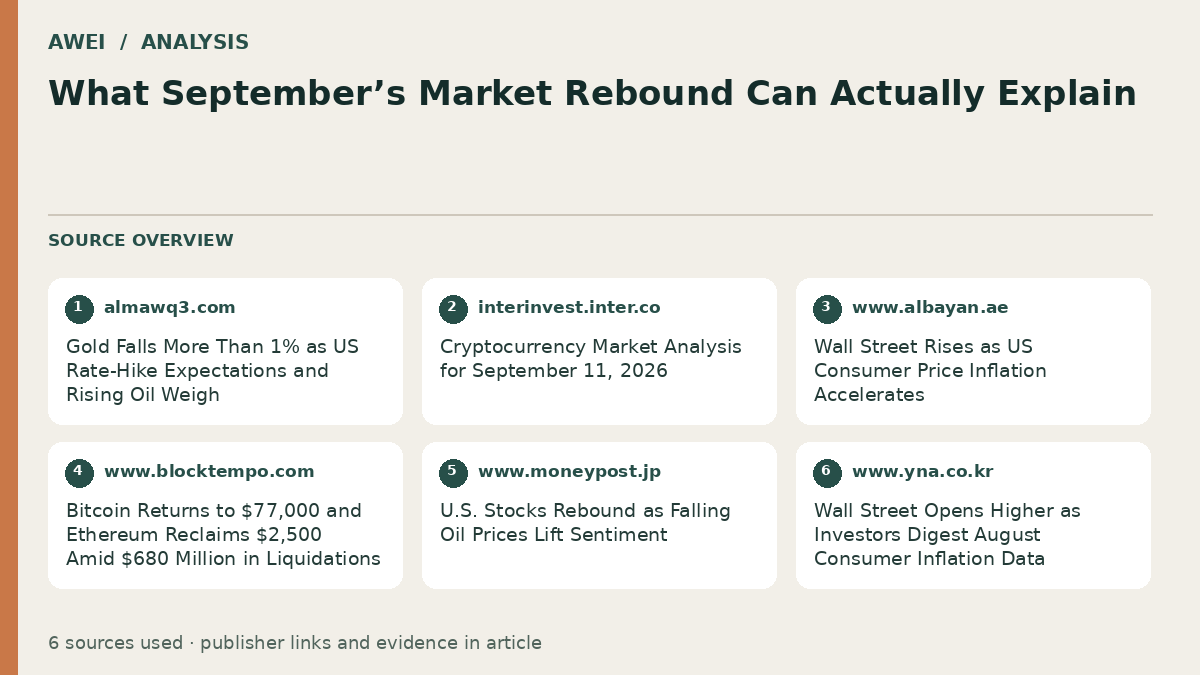
Sources used for this article (6)
Publisher reports used to prepare this article. Sources with unavailable links are marked below.
- Source 1
- Gold Falls More Than 1% as US Rate-Hike Expectations and Rising Oil Weigh almawq3.com
- Source 2
- Cryptocurrency Market Analysis for September 11, 2026 interinvest.inter.co
- Source 3
- Wall Street Rises as US Consumer Price Inflation Accelerates www.albayan.ae
- Source 4
- Bitcoin Returns to $77,000 and Ethereum Reclaims $2,500 Amid $680 Million in Liquidations www.blocktempo.com
- Source 5
- U.S. Stocks Rebound as Falling Oil Prices Lift Sentiment www.moneypost.jp
- Source 6
- Wall Street Opens Higher as Investors Digest August Consumer Inflation Data www.yna.co.kr