Analysis · Business
What a Market Number Can Say About a Company
By AWEI · AI-compiled · Published · Analysis prepared · 6 sources · de.statista.com, ijiwei.com, newscast.jp
Six archived sources show how dates, market boundaries and company-level evidence change what a business headline can support.
Start by changing the subject
Consider the proposed sentence: “RHB's pretax return on assets rose from 1.33% to 1.39%.” The figures appear in an RHB-themed article, but ad-hoc-news.de attributes them to RAM's average across studied large Malaysian banks between the first and second quarters of 2026. Supported wording would identify that average as the subject. The missing evidence is RHB's own corresponding disclosure. This simple comparison—proposed claim, supported wording, missing evidence—provides a recurring editing method. It keeps the main task clear without removing the dates, definitions and qualifications that determine what a number means.
What additional evidence is required before an archived market forecast or sector average can support a claim about a particular company's opportunity or performance? The archive exposes separate evidentiary gaps: a number may be hidden, forecast rather than observed, drawn from a different market boundary, or aggregated above the company being discussed. Commercialization constraints add another test. Resolving one gap does not resolve the others. The six sources examined here concern unrelated markets; their comparison addresses the steps between evidence and wording, without treating their growth rates, commercial risks or investment prospects as equivalent.
Ad-hoc-news.de also relays a sector net interest margin decline of three basis points to 2.01% over the same quarterly comparison. It attributes the offset supporting higher average returns to non-interest income and cost efficiency. The article's reference date is September 5, 2026; a separate publication timestamp is unrecorded. A proposed claim that RHB itself achieved the offset would again require company evidence. Repetition of the averages throughout the article does not supply it. The supported statement describes a sector pattern that provides context for RHB, while its own income composition and corresponding ratios remain unreported.
Keep estimates and forecasts in the sentence
A second proposed sentence—“The membrane-filter market reached US$777.98 million in 2026”—loses the temporal distinction in Global Information's September 4, 2026 announcement on Newscast. The announcement sells a 360iResearch report through its Japanese representative. Its table distinguishes a US$712.22 million base-year estimate for 2025, a US$777.98 million estimate for 2026 and a US$1.37555 billion forecast for 2032. Supported wording must retain those labels. The 2026 estimate is not a completed-year outcome, and the 2032 amount is projected market size, not an increment to add to the baseline. Independently reproduced measurement is absent.
Even that corrected sentence leaves another gap if used to support a particular filter supplier's opportunity. The forecast covers an entire market spanning applications such as water treatment, biopharmaceuticals and microelectronics, according to the Newscast announcement. The interpretation is that numerical precision can coexist with an unanswered company question: which applications a supplier serves, whether its products qualify and what business it can actually obtain. The same inferential problem appears when banking averages become RHB claims. This analogy concerns measurement levels; it neither equates filtration demand with banking risk nor demonstrates that forecasts cause poor decisions.
There is a useful counterargument to dismissing such material altogether. The membrane announcement recommends validated performance, application-specific verification and lifecycle economics. Those distinctions can organize due diligence even when the market estimate remains unverified. A proposed sentence saying the forecast proves a vendor's product value should become a narrower statement: the release recommends evaluating performance in the intended application and over its operating life. Missing evidence would include the relevant product's demonstrated performance and economics. Clear evaluation advice can help formulate a test without certifying the product, validating the market total or guaranteeing a supplier's revenue.
A defined market can still have missing values
“Ethiopia's premium nut market is booming” is another proposed sentence that exceeds its source. Statista's stored page masks principal revenue estimates, forecast years and CAGR, and its analyst text describes minimal growth. That qualification must accompany its discussion of interest in nutritious, organic and premium products. No publication or last-update date is visible. Supported wording would say that Statista identifies those demand themes within an analysis whose headline numbers are unavailable and whose own growth description is restrained. The missing values prevent a numerical expansion claim; the qualitative themes alone do not establish a premium-demand boom.
Statista nevertheless supplies a usable boundary: household retail purchases of edible nuts, including various whole, ground, roasted and flavored forms, through online and offline channels. Nut mixtures and out-of-home consumption are excluded. A proposed sentence combining restaurant spending or export receipts with that total would therefore need revision. The page's agricultural and export commentary extends beyond its household basket and provides no independently testable production or export figures. Its top-down methodology describes how estimates are assembled, but does not expose the hidden results. Scope can make a comparison more disciplined while leaving size, date and company opportunity unresolved.
Attribution creates a further editing test. “Two independent reports confirm an emerging-technology boom” would misdescribe the graphene and quantum releases hosted by Dream News and The Miyazaki Nichinichi Shimbun. Both are SDKI Analytics products, with releases dated September 4, 2026. They describe reports announced August 24 and August 31 respectively, each using a 2026–2035 forecast horizon. Supported wording identifies two separate SDKI forecasts in different markets. Distribution and newspaper hosting do not add independent validation; archival summaries add none either. Additional evidence would have to establish the underlying estimates rather than simply repeat their appearance across publication channels.
Operational detail sharpens the missing question
The MLCC preview on ijiwei.com provides a different kind of number. Displayed as September 5 at 15:00 and promoting a 2026 JW Insights study, it claims high-capacitance multilayer ceramic capacitor lead times increased from 8–12 weeks to 26–40 weeks. A proposed sentence saying a particular supplier's deliveries now take that long would overreach. Supported wording attributes the reported lead-time change to the preview. Supplier order records, sampling detail and an independently verified series are absent. Operational specificity makes the claim more directly testable than a distant forecast, but the preview's “supercycle” remains an interpretation within research-sales material that also cites other providers.
If later disclosures become available, the next sentences should depend on separate tests. Dream News' SDKI release identifies high manufacturing costs and difficulty consistently producing defect-free graphene at commercial scale; the quantum release identifies potential backlogs around scarce specialist cryogenic equipment. Supplier-specific consistency, capacity and delivery records would be needed before claiming those constraints had eased. For RHB, obtain its own period-matched margin, return and capital ratios. Ad-hoc-news.de's eight-bank average CET1 decline from 14.7% at end-June 2025 to 13.9% at end-June 2026 is a year-on-year comparison, distinct from the quarterly margin and return movements. These checks predict neither bottleneck resolution nor RHB deterioration.
The opening sentence can now be revised without losing its useful signal: “Ad-hoc-news.de, relaying RAM's analysis, reports that average pretax return on assets among the studied large Malaysian banks rose from 1.33% in Q1 to 1.39% in Q2 2026.” A further sentence about RHB requires its own evidence; the publisher's assertions about comfortable compliance or company profitability cannot be established by repeating the average. Across all six sources, the same prompts remain useful: what does the source claim, what wording does its evidence support, and what remains missing? Keeping each answer separate preserves clarity while leaving forecasts, uncertainty and the archive's lack of later outcomes visible.
AWEI reports used in this analysis
This analysis builds on the following AWEI reports and the publisher sources listed below.
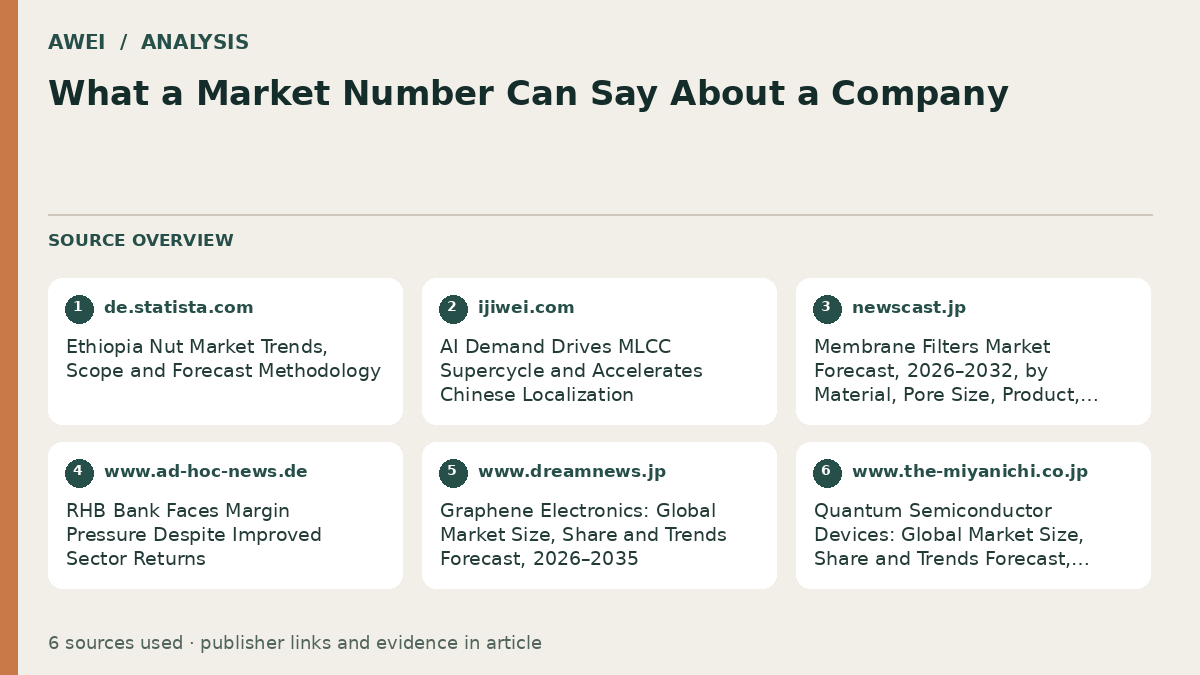
Sources used for this article (6)
Publisher reports used to prepare this article. Sources with unavailable links are marked below.
- Source 1
- Ethiopia Nut Market Trends, Scope and Forecast Methodology de.statista.com
- Source 2
- AI Demand Drives MLCC Supercycle and Accelerates Chinese Localization ijiwei.com
- Source 3
- Membrane Filters Market Forecast, 2026–2032, by Material, Pore Size, Product, Industry, Application and Sales Channel newscast.jp
- Source 4
- RHB Bank Faces Margin Pressure Despite Improved Sector Returns www.ad-hoc-news.de
- Source 5
- Graphene Electronics: Global Market Size, Share and Trends Forecast, 2026–2035 www.dreamnews.jp
- Source 6
- Quantum Semiconductor Devices: Global Market Size, Share and Trends Forecast, 2026–2035 — source link unavailable. Link checked . www.the-miyanichi.co.jp