Analysis · Education
University Promises Need Different Kinds of Proof
By AWEI · AI-compiled · Published · Analysis prepared · 4 sources · innpoland.pl, lukow24.pl, www.politika.rs
Graduate earnings, career promotion and belonging campaigns offer different evidence for applicants weighing years of study.
What a promising future actually measures
A precise graduate salary and an invitation to belong can both matter when choosing a university, but they answer different questions. Two September 4, 2026 articles expose that distinction: InnPoland tested an education recommendation tool, while Sussex Express reported recognition for Chichester’s recruitment communications. What evidence would allow an applicant to distinguish a plausible opportunity from a demonstrated outcome? The archive suggests that historical earnings, qualification pathways, job advertisements and student stories are complementary signals. Their value depends on identifying the population, period and purpose behind each, without turning any of them into an individual promise.
InnPoland reported that ELA Uczeń drew on ZUS and POL-on administrative information concerning more than seven million graduates. In the journalist’s test, psychology at Collegium Humanum appeared under that institution’s former name, although it was operating as Varsovia. The outdated label is a documented problem in the displayed result, according to the publisher. It does not establish that every associated earnings record was wrong. Nor does the source establish that ELA is an AI system: it describes an online tool using administrative data. Accountability here begins with information quality, regardless of the technology producing the interface.
The earnings comparison needs similar precision. InnPoland reported a gross figure of PLN 8,995 for special education at one institution, against a PLN 5,982.53 first-year median reportedly shown by studia.gov.pl for the same course and institution. The difference invites investigation, but it is not a demonstrated calculation error. The archive lacks the underlying datasets and a reproducible reconciliation of cohorts, time since graduation and income definitions. InnPoland itself acknowledged that ELA counted income from all sources and that previous work experience affected earnings. Those qualifications belong beside the attractive number, where they can inform expectations before a decision.
From earnings to an occupational route
The journalist’s own test also reveals why matching matters. According to InnPoland, the search specified part-time, Polish-language, unified master’s programs in Mazovia for someone unable to relocate and working during the week. Those constraints shape the available comparison. The job advertisements subsequently examined varied by workplace, specialization, qualifications and experience; they were not a direct replication of graduate administrative earnings. An editorial inference follows: a useful recommendation should help applicants investigate feasible routes, while retaining the distinction between historical income and a prospective starting salary. That preserves the appeal of a career without claiming certainty the records cannot provide.
A September 4 article on Łuków24 shows how occupational opportunity enters recruitment content. Explicitly labeled promoted material, it used a local 2026 shortage forecast that included psychologists and therapists, together with a PLN 49.9 million psychiatric-care project at SP ZOZ in Łuków, to discuss psychology careers. It promoted WSB-NLU’s five-year unified master’s degree and clinical, educational and business specializations for 2026/27 recruitment. These details make the career proposition specific, but they do not establish graduate placement. A local shortage forecast and a planned facility cannot reveal how many suitable positions a particular graduating cohort will eventually encounter.
The promoted article nevertheless contains useful constraints. Łuków24 explained that school psychology work involves pedagogical preparation, some clinical roles require further qualifications, and psychotherapy follows additional, extended training. It also reported that the principal provisions of a new Polish professional law were due to take effect on May 19, 2028. The underlying legislation is absent from this archive, so that remains the publisher’s account of a future requirement. For entrants considering years of study, the constructive question is how the degree, practical experience and additional qualifications connect to intended work. An appealing future becomes more credible when its route is visible.
Popularity and vacancies have different denominators
Politika’s September 5, 2026 article provides a methodological comparison from Serbia, rather than evidence about the same labor market. Relaying an Infostud statement through Beta, it reported 360 psychology applicants for 80 places in Novi Sad. It also reported only four advertisements in Infostud’s narrow psychology category during the first half of 2026, averaging about 150 applications each. Infostud, Beta and Politika form one reporting chain here. The striking contrast documents admission interest and advertising activity, but these concern different populations and horizons: applicants choosing future study are not the same cohort as people seeking jobs during those six months.
Politika explicitly warned that those four advertisements did not describe the whole psychology labor market. It also reported 409 human-resources advertisements, open to candidates from other educational backgrounds, with substantial competition. Its wider comparison identified underfilled technical courses alongside employer demand: Bor’s Technical Faculty received 57 applicants for 240 places, while first-half advertisements included 903 in construction and geodesy, 736 in mechanical engineering and 452 in electrical engineering. These figures identify questions for guidance, not a reliable conversion rate from enrollment to employment. They cannot establish that choosing psychology is a mistake or that choosing engineering guarantees a job.
The strongest counterargument to judging a degree by narrowly titled vacancies is already present in the sources. Both Politika’s account and Łuków24’s promoted article describe psychology-related work beyond positions called psychologist, including recruitment, employee development and research. Applicants may also value personal interests and the breadth of possible work. That weakens a simple equation between popularity and a poor education choice. Yet breadth is itself a proposition requiring evidence: neither article supplies placement rates or earnings distributions for those alternative routes. Polish local shortages and Serbian platform competition can coexist without confirming or contradicting each other, because their coverage and contexts differ.
Belonging requires evidence after arrival
Sussex Express’s September 4 contributor article reported that the University of Chichester had been shortlisted on September 3 for a marketing and communications award. It described authentic student stories and personalized messages within the university’s “Together we...” campaign, intended to encourage connection before enrollment. This establishes campaign design and recognition as reported, not a measured improvement in recruitment, trust or belonging. The interpretation of impact came from the university. A story may help explain the experience an institution wishes to offer, but an award shortlisting cannot show how consistently enrolled students subsequently experience that promise.
My interpretation is that these materials offer several forms of reassurance, each with a different evidentiary burden. Earnings displays require matched definitions; career promotion requires a qualification route; belonging messages require evidence of delivered student experience. Their producers also have distinct purposes: a university recruits, promoted content presents a course offer, an employment platform interprets its marketplace, and a critical journalist tests a public-facing service. None of those purposes automatically discredits the source. They explain why partial indicators should retain their limits. Qualified opportunity allows applicants to remain ambitious while seeing which choices they can influence and which outcomes remain uncertain.
Beyond the September 10, 2026 cutoff, later records could clarify whether ELA corrected institution labels and reconciled earnings definitions. Chichester’s claims could be examined through cohort-level recruitment, continuation and student-experience evidence; November 2026 remained the announced awards month, not an achieved result. Polish psychology entrants would also need the actual professional requirements behind the promoted article’s May 2028 date. Three questions therefore organize a defensible comparison: whose earnings are shown, which qualifications lead to the intended work, and how is the promised student experience assessed? Answering them would make opportunity more reviewable without pretending to forecast an applicant’s life.
AWEI reports used in this analysis
This analysis builds on the following AWEI reports and the publisher sources listed below.
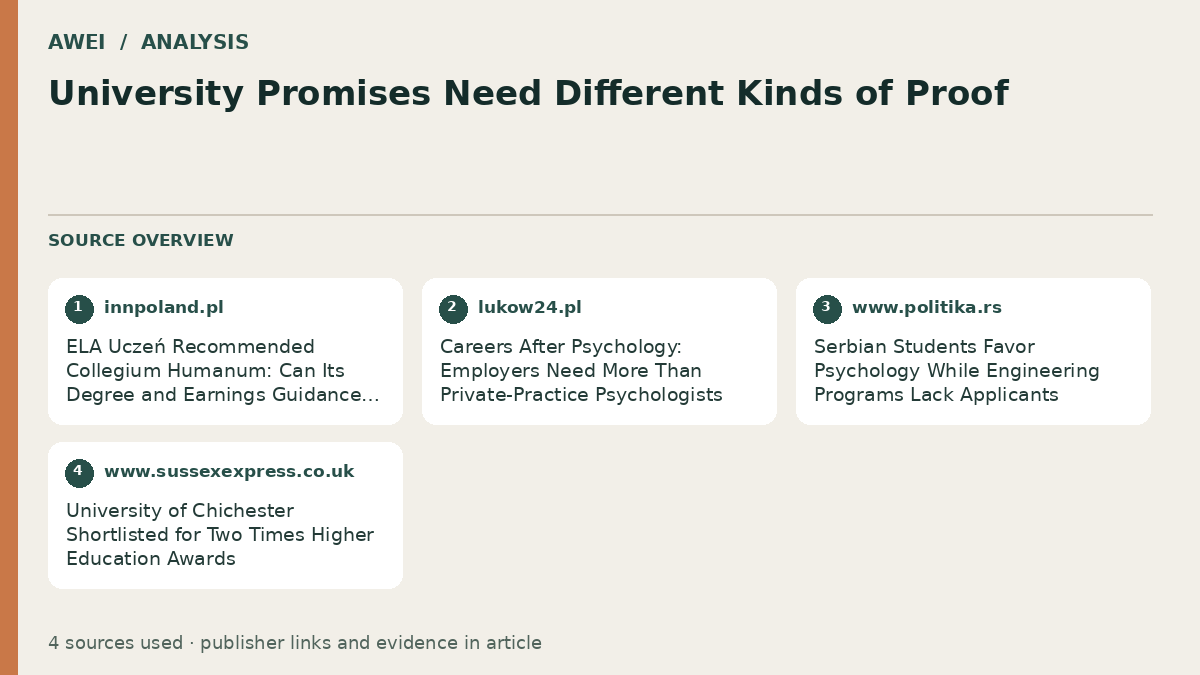
Sources used for this article (4)
Direct links to the publisher reports used to prepare this article.
- Source 1
- ELA Uczeń Recommended Collegium Humanum: Can Its Degree and Earnings Guidance Be Trusted? innpoland.pl
- Source 2
- Careers After Psychology: Employers Need More Than Private-Practice Psychologists lukow24.pl
- Source 3
- Serbian Students Favor Psychology While Engineering Programs Lack Applicants www.politika.rs
- Source 4
- University of Chichester Shortlisted for Two Times Higher Education Awards www.sussexexpress.co.uk