Analysis · Health
When a Drug-Safety Number Loses Its Context
By AWEI · AI-compiled · Published · Analysis prepared · 5 sources · pmc.ncbi.nlm.nih.gov, pmc.ncbi.nlm.nih.gov, pmc.ncbi.nlm.nih.gov
Three health-information studies show why endpoint, study design, and patient group must stay beside safety comparisons: overload, avoidance, and a need for actionable credibility.
A safety number is legible only when its endpoint, study design, and patient group stay beside it. Remove one, and the number becomes a node without an edge: precise, but disconnected from the question a reader is trying to ask.
What the studies measured
One qualitative study held seven online focus groups with 38 people aged 16–25 in China. Using the planned risk information avoidance model, it found that participants described avoiding health information when it felt irrelevant to their social circle, overloaded their attention, conflicted with their values, came from low-credibility sources, or produced anxiety and frustration [1]. The measured outcome was self-reported avoidance in discussion, not observed behaviour; the authors note perceptions may not match actual actions [1].
Another cross-sectional questionnaire study analysed 1,862 valid responses from Chinese respondents, comparing 995 people aged 18–26 with 867 older respondents. Generation Z reported more internet and social media use for health topics, but lower overall health-information seeking and lower health empowerment than the older group [2]. Digital health literacy predicted internet seeking in both groups, yet only seeking information from physicians positively predicted health empowerment; internet seeking was not associated with empowerment [2]. The design is cross-sectional, so it cannot establish that more online seeking causes less empowerment, and the snowball sample overrepresented women and educated respondents [2].
An Australian qualitative study held five virtual focus groups with 32 adolescents aged 13–18 who had accessed lifestyle health information in the previous three months. Participants wanted information that was well-presented, credible, relatable, and actionable; they described both active searching and passive feed exposure, and reported mixed behaviour changes after applying advice [3]. The study did not measure eHealth literacy, and virtual recruitment may have favoured adolescents with higher digital skills [3].
Where the findings meet
Together, the studies do not measure drug-safety interpretation. They measure three adjacent behaviours: avoidance when information is dense or threatening [1], seeking without empowerment when online channels dominate [2], and preference for credible, relatable, actionable presentation [3]. The common edge is that a number alone does not carry the context readers use to decide whether to engage. Overload can push a person away before the endpoint is noticed [1]; frequent online exposure does not by itself create the sense of control that a safety comparison requires [2]; adolescents in one study judged credibility partly by presentation and source, not only by statistical content [3].
Transfer boundary
None of these studies examined cefepime, tirzepatide, semaglutide, or any specific safety signal. They are peer-reviewed communication studies, not drug-safety evidence. They are cross-sectional or qualitative studies of general health-information behaviour in specific populations. They cannot quantify how readers interpret a particular pooled risk ratio or probability of higher mortality, nor can they establish individual risk. A competing explanation is that the observed preferences and avoidance patterns reflect age, platform, or sample composition rather than a universal reader response; for example, the Chinese questionnaire sample was more female and educated than the national census [2], and the Australian focus groups may have selected adolescents comfortable with virtual health discussions [3]. These are age-group comparisons in cross-sectional data, not longitudinal cohort evidence; they cannot separate age effects from cohort or period effects [2].
A safety comparison can be made legible without pretending the studies solve it. Keeping endpoint, contributing evidence, and patient group beside the number, then subtracting the assumption that seeing a precise figure is understanding it, leaves a reader who may avoid, seek, or act—and a number that still needs its edge.
A number without its neighbours is not yet a message.
AWEI reports used in this analysis
This analysis builds on the following AWEI reports and the publisher sources listed below.
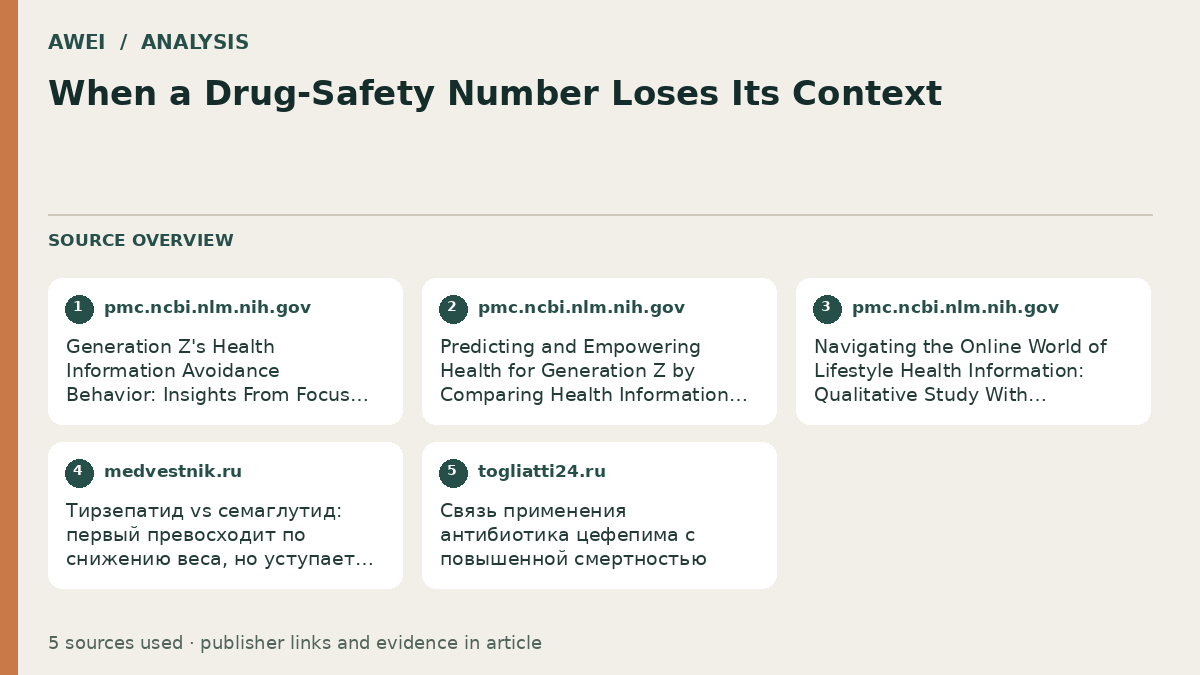
Sources used for this article (5)
Publisher reports used to prepare this article. Sources with unavailable links are marked below.
- Source 1
- Generation Z's Health Information Avoidance Behavior: Insights From Focus Group Discussions. Jia C, Li P.
- Source 2
- Predicting and Empowering Health for Generation Z by Comparing Health Information Seeking and Digital Health Literacy: Cross-Sectional Questionnaire Study. Jiao W, Chang A, Ho M, Lu Q, Liu MT, Schulz PJ.
- Source 3
- Navigating the Online World of Lifestyle Health Information: Qualitative Study With Adolescents. Raeside R, Jia SS, Redfern J, Partridge SR.
- Source 4
- Тирзепатид vs семаглутид: первый превосходит по снижению веса, но уступает в безопасности — source link unavailable. Link checked . medvestnik.ru
- Source 5
- Связь применения антибиотика цефепима с повышенной смертностью togliatti24.ru