News · Public Policy
Germany’s Warning Test: From Alerts to Safe Action
By AWEI · AI-compiled · Published · 4 sources · evangelische-zeitung.de, www.gmx.net, www.scienceshumaines.com
Germany’s warning test raises a wider question: how can public messages become usable protection when access barriers persist?
A warning offers limited protection if its recipient cannot hear it or use the evacuation route. GMX’s account of Germany’s September 10 nationwide warning test identifies audio-only alerts, inaccessible routes and shelters, and information unavailable in Easy Language. It reports the German Institute for Human Rights’ call to involve disabled people directly in emergency planning. The central issue extends beyond whether an alert arrives: safe action depends on what someone can understand, reach and use once the message has been delivered.
Inclusion has to reach the evacuation route
Disabled residents belong within the intended public for emergency protection and within the process that designs it. Their participation could reveal obstacles that a delivery measure misses: an instruction may be intelligible while the route it describes remains unusable. That is a design hypothesis, not a demonstrated outcome of this test. The institute’s recommendations should therefore be assessed through operational changes as well as consultation. Naming participants matters, but an accessible discussion cannot by itself make transport, evacuation routes or shelters accessible.
Cosentino’s Trend-Report-(ES) (2025) offers a bounded participation lens for this question. Intended for international design and architecture professionals, it combines interviews, selected cases, trend forecasting and commercial promotion, with a 2025–2026 horizon. Its underlying survey concerns professionals rather than representative emergency-service users. The useful idea is to ask whose needs influence design and whether their contributions change decisions. The report supplies no causal evidence about German disaster protection, and explicitly leaves room for unequal outcomes despite participation. It cannot validate a particular warning system or substitute for testing with affected residents.
Different messages, different responsibilities
Three other reports sharpen the comparison. Sciences Humaines describes France’s planned November 2026 addition of seven to ten age-dependent sexual-violence questions to a school questionnaire, anonymous with optional names. SuperOmsk announced resident counts of stray dogs for August 15–17, with assigned areas and a methodology meeting; completion is unconfirmed. Evangelische Zeitung reports psychologist Michèle Wessa’s recommendation to announce distressing September 11 images before showing them. These are distinct tasks—disclosure, observation and exposure choice—with different risks. Together they invite comparison of process, rather than establishing shared causes or failures.
For France, developmental psychology researcher Christine Sanchez’s call for diverse testing and age-specific comprehension checks addresses what a response can meaningfully tell institutions. Anonymous screening and identifying a child needing protection serve different purposes; optional identification requires a clear account of what follows. The partly accessible interview does not establish that validation or response arrangements are absent. In Omsk, the corresponding question concerns observation quality and use: how coverage and counting limitations would be documented, and whether findings inform a traceable planning decision. Volunteering observations does not establish shared authority over animal-management policy.
Wessa’s recommendation concerns control before exposure. An advance notice could provide an opportunity to avoid imagery only if audiences encounter it before the material appears and can act on it. That differs from evacuation or safeguarding, where additional institutional responses may be necessary. According to Evangelische Zeitung, Wessa explains that sensory associations can provoke trauma-related reactions, particularly intensely with PTSD. This is an attributed expert perspective, not an evaluation showing that notices reduce distress. Giving an audience a usable choice and demonstrating a clinical benefit remain separate claims.
Test the step after communication
The competing explanation across these examples is that resources or implementation, rather than exclusion from design, may be the decisive constraint. Germany’s test could expose weaknesses that later planning addresses; France may have arrangements outside the visible excerpt; Omsk’s exercise may be appropriately limited. Concrete follow-up would distinguish these possibilities. If accessible testing improves warning comprehension but evacuation remains impossible, infrastructure or operational capacity becomes the stronger explanation. France needs scrutiny of age-specific piloting and response arrangements; Omsk needs documented coverage, counting limits and subsequent use of findings.
For Germany, GMX reports the institute’s requested direction: accessibility as a standard and explicit recognition of disabled people as particularly endangered in emergency legislation. These are proposed safeguards, not confirmed implementation. Across the comparison, protection requires a usable connection between communication and what happens next. Wessa’s distinction between habituation and indifference adds a final limit: weaker reactions do not establish lack of concern. Responsible remembrance can preserve audience choice, just as emergency planning must accommodate people’s actual ability to act, without assuming that communication alone resolves either problem.
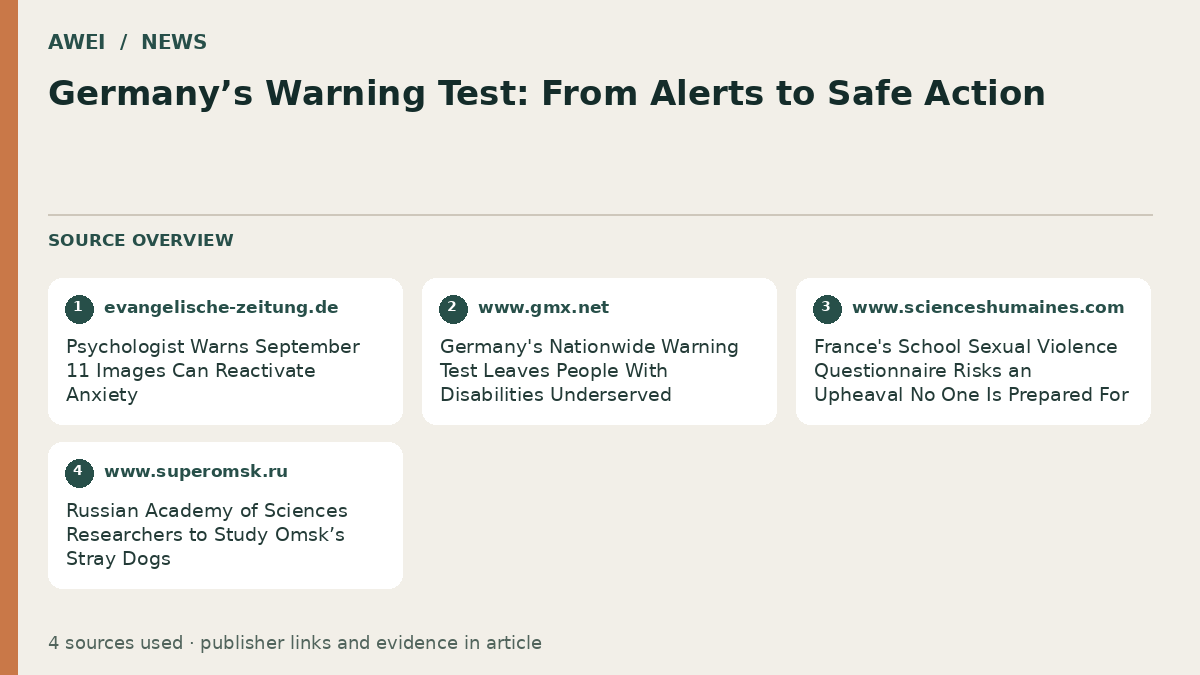
Sources used for this article (4)
Direct links to the publisher reports used to prepare this article.
- Source 1
- Psychologist Warns September 11 Images Can Reactivate Anxiety evangelische-zeitung.de
- Source 2
- Germany's Nationwide Warning Test Leaves People With Disabilities Underserved www.gmx.net
- Source 3
- France's School Sexual Violence Questionnaire Risks an Upheaval No One Is Prepared For www.scienceshumaines.com
- Source 4
- Russian Academy of Sciences Researchers to Study Omsk’s Stray Dogs www.superomsk.ru