Analysis · Technology
AI Prototypes Need Evidence for Everyday Use
By AWEI · AI-compiled · Published · Analysis prepared · 4 sources · corp.neo-m.jp, eu.36kr.com, ulis.vnu.edu.vn
AI approval, technical demonstrations and implementation pledges answer different questions from sustained service quality and cost.
Clear cost-effectiveness was an approval consideration for 43.7% of 540 Japanese B2B purchasing participants in Neo Marketing’s September 11, 2026 report, while 19.3% had prepared an ROI calculation. The online survey, conducted August 17–18, concerned general purchasing involvement during the preceding year, not specifically AI projects. It raises a useful question for operations and procurement leaders: what evidence makes a proposal assessable, and what additional evidence would justify using its technology routinely?
The distinction creates a constructive next step. A project can become more evaluable by specifying the task, expected benefit and continuing work required. That improves the clarity of the decision without promising that approval, deployment or greater technological ambition will produce the intended result. This September 14 archival analysis applies those questions separately to water operations, physical world models and university services.
Approval evidence has a limited role
Among 104 ROI-calculation users in Neo Marketing’s survey, 33.7% described very strong influence on approval. The publisher goes further by presenting the calculations as effective when used. Respondents’ perceived influence cannot establish that preparing a calculation caused approval, still less that the approved purchase subsequently delivered its projected returns. Strong proposals, supportive decision-makers or affordable projects could help explain both the use of calculations and favorable assessments.
The distinction between the 43.7% prioritizing cost-effectiveness and the 19.3% preparing calculations also leaves several explanations open. Some purchases may have been justified through other evidence; some projected benefits may have been difficult to quantify. The figures do not identify a group whose missing calculation caused rejection. Likewise, questions about proposal revisions and abandoned purchases describe separate experiences, not successive stages of a measured failure process. Revision can be useful scrutiny.
Neo Marketing’s unrelated cycling-enforcement highlight and inconsistent counts of evidence categories warrant additional care. They do not automatically invalidate every response, but they weaken the case for accepting the publisher’s broad efficacy language without checking the underlying reporting. An ROI document remains useful as a place to expose assumptions, costs and alternatives. Its projections acquire stronger support only when subsequent operating evidence can be compared with them.
Follow the work after the demonstration
China Water Network’s September 7 adaptation of Environmental Business Journal contributions supplies operational detail for that comparison. Its Brown and Caldwell overview emphasizes SCADA data, historical operating records, process models and digital twins. Its FlipType overview adds defined uses, data management, output review, employee training and continuing risk governance. These are summarized engineering and software-provider perspectives, not independent measurements of the benefits their proposed arrangements deliver.
Their significance lies in identifying work that a software demonstration may leave outside its frame. An output becomes operationally useful when it reaches a relevant decision and someone can assess it. Data maintenance, corrections and unusual cases can require staff effort after installation. If that work is omitted from the cost case, a project could appear efficient while transferring duties to operational teams. The source does not establish that such a transfer occurred; it gives procurement leaders concrete responsibilities to investigate.
Physical deployment adds a different requirement. EqualOcean’s September 10 world-model overview, hosted by 36Kr, identifies scarce interaction data, computing costs and simulation-to-reality transfer as commercialization obstacles. A model can produce a convincing demonstration while leaving its performance on actual hardware unresolved. For a task involving physical action, useful evaluation must examine whether predicted behavior holds under the conditions in which the equipment will operate, including the human intervention it requires.
EqualOcean’s timetable remains a forecast: prototype optimization in 2026–2027, limited industry deployment in 2028–2030 and broader infrastructure maturity after 2030. The overview provides no comparative benchmarks validating its company descriptions or that sequence. Its distinction between technical feasibility and commercial viability is nevertheless analytically useful. A system may perform a task but cost too much to operate, or provide worthwhile narrow performance without attaining the broader capability envisioned in an industry outlook.
This supports three proposed checks: performance on the intended task, benefits after operating costs, and responsibility for continuing review and maintenance. Their content must match the application. A university administrative tool does not inherit a robot’s physical-validation requirements, while a utility cannot establish dependable operation through an administrative usage count. The sources do not demonstrate that these checks form a universal causal pathway to successful adoption.
Implementation support makes a promise examinable
ULIS at Vietnam National University, Hanoi, explicitly places activity after the competition. Its announced November 5–6, 2026 hackathon combines 24 hours of creation with 90 days of implementation, VND180 million in prizes and VND5 million preparation support for teams passing content screening. Registration is required before 17:00 on September 18. Both dates remained ahead on September 14; the notice supplies no explicit time zone or visible publication date.
Preparation funding could help teams develop a proposal before judging, while the implementation period creates an opportunity to test it in ordinary work. Neither establishes that enough resources have been assigned for every project. Every university unit must register a team, which broadens required participation but also raises a question about differing workloads and technical capacities. Those possible benefits and burdens are unmeasured. Planned institutional recognition for winning products likewise establishes a reward, not an operational outcome.
The institutional question is how recognition for innovation connects to responsibility for a dependable service. Demonstrations, approvals and awards provide bounded milestones. Review, staff preparation, maintenance and correction require continuing resources. If the people receiving recognition and those sustaining the work face different commitments, costs could become less visible at approval. Conversely, ULIS’s explicit implementation period could help connect those stages. The announcement makes that possibility assessable without proving its eventual effect.
McKinsey’s The State of AI 2025, published in November 2025, offers an adoption-versus-maturity lens. Its evidence is an online, GDP-weighted survey of organizational participants across countries and industries, reporting 2025 experience with historical comparisons. Responses and attributed financial returns are self-reported; definitions of regular use changed across survey years, and associations with workflow redesign do not establish causation. This global organizational framework cannot validate the projects discussed here, establish employee confidence or substitute for locally appropriate service measures.
A plausible alternative to extensive redesign is a narrow tool working within an existing process and review arrangement. EqualOcean itself says that not every business needs a complete world model. Modest observed gains could also reflect an unsuitable task or an evaluation conducted too early, rather than a general implementation failure. The water contributors and EqualOcean already acknowledge constraints; these accounts do not show institutions uniformly ignoring them. The partial water adaptation is one mediated source chain, and no shared project dataset links the settings.
If later follow-up after ULIS’s announced implementation period documents maintained tools, assigned reviewers and better service with lower total staff effort, the case for routine use would strengthen. Training, corrections and maintenance should be counted alongside time saved, against a suitable baseline or simpler alternative. Physical-model projects would additionally need real-hardware evidence. If extensive integration costs more without outperforming a narrow tool, the simpler-fit explanation gains weight. Continued use or an award alone cannot resolve those comparisons.
AWEI reports used in this analysis
This analysis builds on the following AWEI reports and the publisher sources listed below.
Sources used for this article (4)
Publisher reports used to prepare this article. Sources with unavailable links are marked below.
- Source 1
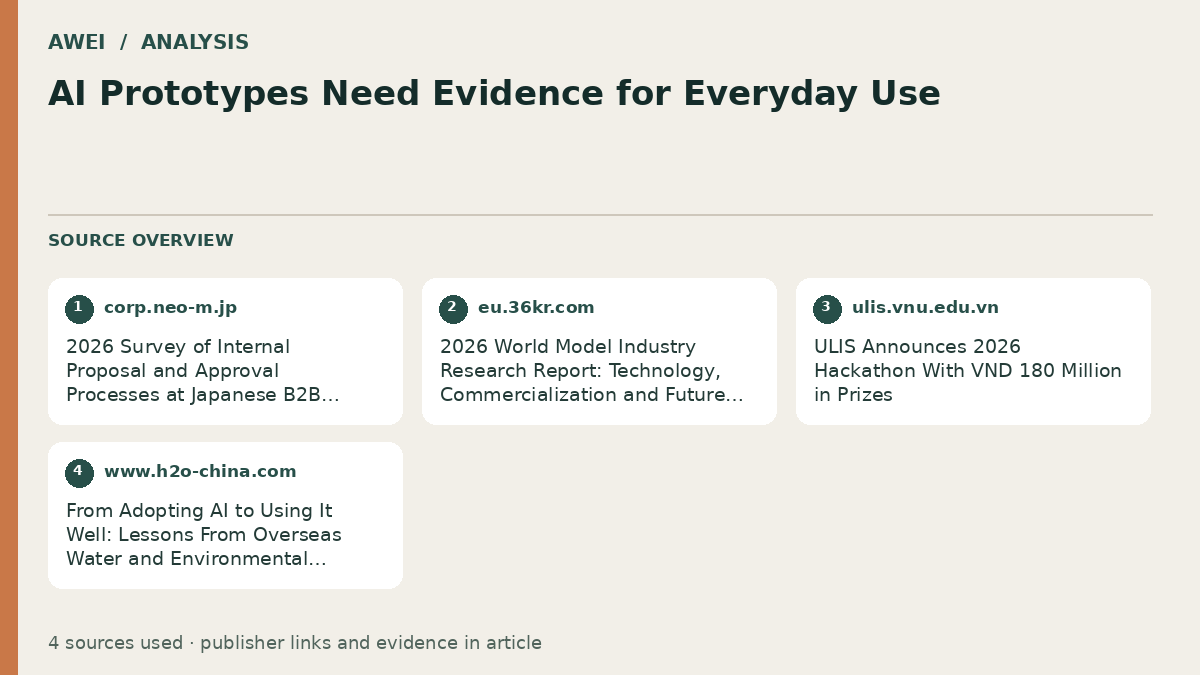
- 2026 Survey of Internal Proposal and Approval Processes at Japanese B2B Companies corp.neo-m.jp
- Source 2
- 2026 World Model Industry Research Report: Technology, Commercialization and Future Outlook eu.36kr.com
- Source 3
- ULIS Announces 2026 Hackathon With VND 180 Million in Prizes ulis.vnu.edu.vn
- Source 4
- From Adopting AI to Using It Well: Lessons From Overseas Water and Environmental Companies www.h2o-china.com