Analysis · Business
Why Retailers Leave Social Platforms—or Join Them
By AWEI · AI-compiled · Published · Analysis prepared · 6 sources · gorontalo.antaranews.com, hu.euronews.com, rri.co.id
LUSH's platform exit and Indonesian traders' digital entry reveal different business needs, with neither strategy proven superior.
Different starting points change the choice
LUSH could distribute a campaign critical of social platforms through its existing stores and website. Klewer Market trader Fitri Istianatun wanted to learn how to create an account and sell through TikTok. Their contrasting choices raise a question about retail strategy: how much does a business’s route to customers determine whether leaving a platform or joining it is feasible? The comparison suggests that available channels and practical capabilities matter alongside consumer preferences. It does not establish that either approach produces better sales, margins or experiences for the people using it.
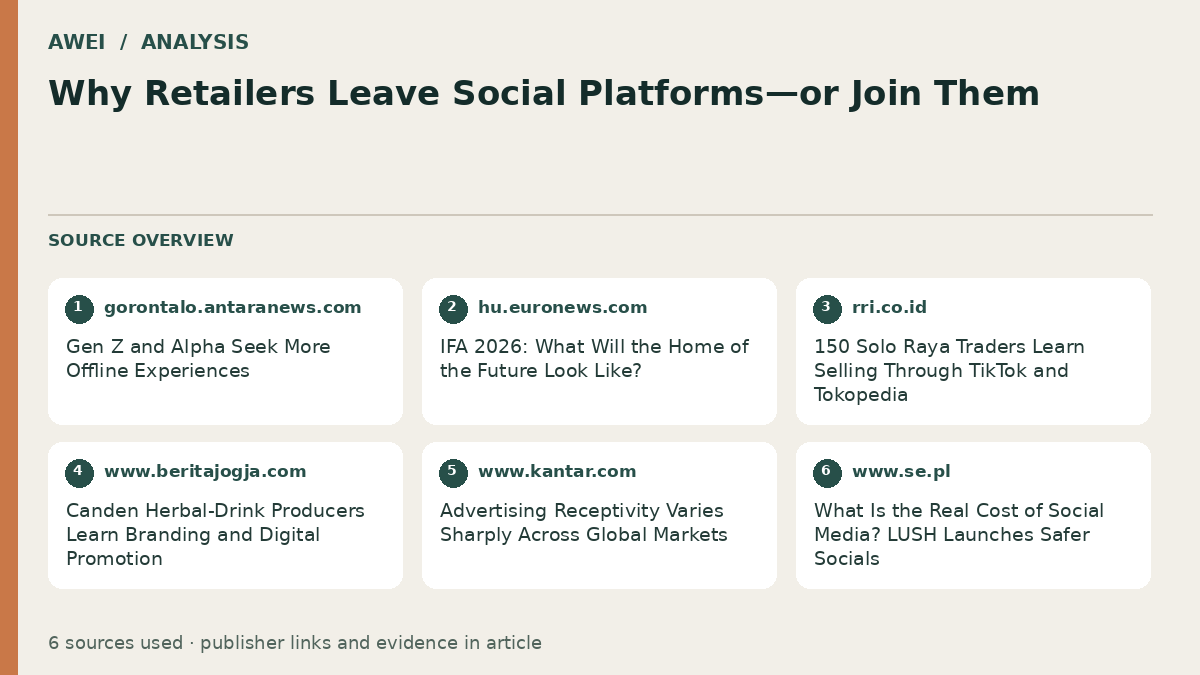
SE.pl’s September 3, 2026 article, explicitly labelled press material, announced LUSH’s Safer Socials campaign across its stores from early September. It described an educational website and earlier withdrawals from major networks, including X in 2023. RRI’s September 6 report described training for 150 Solo Raya merchants on September 4. Istianatun said she had used TikTok to watch content and shop but had not sold through it, and linked her interest in learning to quiet conditions at Klewer Market. These reports establish announced activities and one trader’s account, without comparable commercial results.
The difference in starting positions makes both decisions intelligible. LUSH already has physical locations through which it can communicate its position. Istianatun is investigating another way to find customers for an existing business. Established distribution may make platform withdrawal more feasible, while access to additional discovery may make entry worth learning. That is an explanatory hypothesis, not a demonstrated cause of either decision. The sources disclose no comparable audience reach, acquisition costs or budgets. They also cannot establish that TikTok caused a market-wide decline in physical footfall from one merchant’s description of her circumstances.
Access creates another set of tasks
The Canden herbal-drink training makes some of the work behind digital entry visible. Berita Jogja’s undated second-page excerpt describes participants practising simple product photography, developing names and brand stories, and preparing WhatsApp Story advertisements with a headline, message and invitation to act. These exercises identify specific tasks beyond obtaining an account. They connect a commercial aspiration to something participants can practise and inspect. The excerpt supplies no outcome evaluation, however, so participation cannot be converted into claims about retained skills, greater confidence, higher productivity or additional sales.
This practical distinction matters for merchants deciding where to spend working time. Wanting more customers leaves open how to present a product, answer enquiries and complete orders. A photograph or clear promotional message can make the next task more defined, but those activities still require resources. If content production takes time from other work, its value depends partly on the additional business it generates. Training may expand the choices available to a seller without making every choice worthwhile. Progress should remain attached to the merchant’s own objective and capacity, rather than an expectation that effort alone overcomes commercial constraints.
DoubleVerify’s Global Insights 2025: How Consumers and Marketers Use Walled Gardens supplies a limited lens for platform entry. Its March 2025 voluntary online consumer survey spans 21 countries and asks about purchasing during the preceding 12 months. The conceptual proposition is that embedded commerce can place discovery and transaction close together. That could help explain merchants’ interest, but the media-verification vendor’s survey does not causally test convenience or merchant returns. Its regional findings cannot stand in for Indonesian sellers, and incomplete methodological detail limits transfer. Channel use establishes neither purchase quality nor consumer wellbeing.
Preferences do not travel unchanged
Kantar provides a different empirical counterweight to universal channel advice. Its September 7, 2026 article reports 2025 research involving 21,267 consumers across 30 markets and 974 senior marketers. Kantar identifies substantial differences between markets and no overlap between consumers’ and marketers’ top-five advertising-platform rankings. It also describes relatively high Indonesian advertising receptivity within an Asia-Pacific region containing sharply different responses. These are findings about advertising attitudes. They do not measure Istianatun’s customers, actual purchases, changes in young people’s screen time or the return from a particular merchant’s campaign.
The mismatch between professional preferences and consumer responses suggests a useful question for channel selection: whose evidence informs the decision? Familiar platforms or industry enthusiasm might be poor guides to a specific audience, although Kantar’s rankings alone cannot establish inefficient spending. Marketers may pursue reach, formats or objectives that an attitude ranking does not capture. Likewise, favourable receptivity need not generate profitable demand. Kantar sells research services, which warrants scrutiny of its interpretation without making the findings false. Its evidence supports local investigation and clearer objectives rather than automatically reallocating budgets to whichever platform ranks highest.
Selective use is also consistent with the offline account. In ANTARA’s September 6 report, marketing analyst Yuswohady describes young people seeking direct experiences and points to gathering places such as Blok M, Harmoni and Dukuh Atas. He explicitly says the tendency does not mean abandoning online channels. This is one analyst’s interpretation, including observations about transit-linked places, rather than measured generational screen-time change. Physical gatherings and advertising receptivity can coexist. More fundamentally, different campaign purposes and product categories may explain LUSH’s and the merchants’ choices better than differences in channel resources: activism and sales training are not equivalent performance tests.
Count the work behind the promised benefit
IFA supplies a brief comparison about advertised outcomes. Euronews described exhibitors proposing less demanding interaction through connected household routines and TCL’s simplified reading mode. The Berlin exhibition ended on September 8, 2026. Its promised attention benefits remained unresolved in Euronews’s account, whose Hungarian version is labelled an AI translation and includes exhibitor claims. Evaluating such products would require observing whether they reduce total attention demands, including setup and continued operation. A demonstration of one simplified task cannot establish the overall result. That distinction also applies to channel strategies: an attractive proposition needs evidence matched to the benefit being claimed.
The allocation of work is consequential even when outcomes remain uncertain. Platforms could gain sellers and commercial content as merchants take on learning and production tasks. LUSH’s owned channels offer control over campaign context while still requiring resources to maintain and attract an audience. Neither route eliminates distribution work. These are possible costs and benefits, not measured results in the reports. They suggest a potential feedback mechanism: businesses able to sustain content and fulfilment might capture more benefit from platform access, while those lacking that capacity could struggle despite completing training. The selection cannot establish whether that mechanism operated here.
A later evaluation should compare sustained incremental sales and margins with content-production time, fulfilment costs and the expense of maintaining each channel. It should distinguish additional orders from purchases displaced from elsewhere, and campaign reach from sales objectives. Gains concentrated among sellers able to maintain these activities would support the capability explanation; outcomes tracking product category and local demand despite similar capabilities would favour the alternative. Kantar’s announced September 29, 2026 report remained forthcoming on the analysis date and could update preferences, but would not settle merchant profitability or attention benefits. Each business needs evidence tied to its own choice.
AWEI reports used in this analysis
This analysis builds on the following AWEI reports and the publisher sources listed below.
Sources used for this article (6)
Publisher reports used to prepare this article. Sources with unavailable links are marked below.
- Source 1
- Gen Z and Alpha Seek More Offline Experiences gorontalo.antaranews.com
- Source 2
- IFA 2026: What Will the Home of the Future Look Like? hu.euronews.com
- Source 3
- 150 Solo Raya Traders Learn Selling Through TikTok and Tokopedia rri.co.id
- Source 4
- Canden Herbal-Drink Producers Learn Branding and Digital Promotion — source link unavailable. Link checked . www.beritajogja.com
- Source 5
- Advertising Receptivity Varies Sharply Across Global Markets www.kantar.com
- Source 6
- What Is the Real Cost of Social Media? LUSH Launches Safer Socials www.se.pl