Analysis · Finance
Egyptian Gold Buyers Need More Than a Price Match
By AWEI · AI-compiled · Published · Analysis prepared · 3 sources · www.litefinance.org, www.masrawy.com, www.masrawy.com
A September gold price matched an earlier buying band, but Egyptian buyers still need evidence on costs, currency and resale.
A price can fall inside a buying range without showing whether buying there was worthwhile. Masrawy reported gold at approximately $4,325 an ounce on September 10, 2026, within the $4,320–$4,380 range Ahmed Fahim had described as suitable for buying in its September 6 report. For an Egyptian saver, the meaningful comparison extends to what bullion costs in pounds and what a later sale would recover. This September 14 archival analysis cannot score that completed transaction.
Define the purchase before evaluating the call
Fahim, Golden Arena’s co-founder, expected strong volatility over the following ten days. His comments accompanied a partnership involving Saudi Golden Arena, Egyptian Al Malaz Al Amen and bullion manufacturer KH, intended to facilitate bullion transactions, according to Masrawy. Ten days defined his volatility outlook; it did not supply a complete holding period or exit rule for his buying assessment. Treating entry into the band as success would therefore answer a question the commentary had not fully specified.
The service proposition adds another part of the decision. Easier transactions could have value through improved access, executable quotes or costs. Masrawy measures none of those changes. A provider might gain business while customers gain convenience, yet customers would still bear subsequent price movements. Evaluating the partnership requires identifying which transaction conditions changed, independently of whether a market opinion later looks favorable.
Masrawy also quotes iSagha chairman Saeed Embaby connecting local gold prices to the dollar–pound exchange rate. He cites uncertain forecasts of EGP47, EGP55 and EGP57 per dollar and estimates that each EGP1 increase in the dollar rate adds approximately EGP120 per gram to 21-karat gold. That contextual estimate cannot function as a fixed conversion rule across prices and products. An international per-ounce observation still leaves the executable Egyptian quote for a particular bullion product unspecified.
If dollar gold falls while a dollar costs more pounds, the movements could offset one another in local pricing; movements reinforcing each other could amplify the change. Buying and resale costs introduce a further difference between a quoted market level and money recovered. These are conditional mechanisms, not a reconstruction of any customer’s result. A useful written comparison would identify the product, purchase currency, buying and resale terms, and evaluation period before assigning a verdict.
Different horizons can make different calls compatible
LiteFinance analyst Alex Rodionov’s September 10 gold commentary described a short-term bearish scenario with a remaining downside target of 4,282 and invalidation above 4,464. By September 14, those daily instructions belonged to an elapsed trading date. They illustrate how a view can specify a failure condition, without becoming current trading instructions. The broker’s displayed 11:48 timestamp also cannot be assumed to align with Masrawy’s afternoon account.
A buyer considering a longer holding period and a trader assessing a short-term decline could regard the same price differently. The sources do not establish those precise intentions, but different horizons and entry conditions plausibly explain apparently conflicting calls. Explicit invalidation makes a scenario more assessable; it does not demonstrate forecasting skill. Fahim’s full ten-day volatility window had not elapsed on September 14, and selecting one favorable observation within it would not complete the evaluation.
The later Masrawy article places the reported $4,325 price after a rise to roughly $4,423. Interviewee Mahmoud Nagla argues that Federal Reserve guidance can matter more than an anticipated decision: new language could change expectations about subsequent rates even when the immediate choice is unsurprising. That is a proposed repricing mechanism. The report identified September 15–16 as the forthcoming meeting and contains no outcome from that meeting.
Reconstructing the expectations behind the earlier reversal remains difficult. Masrawy juxtaposes a Reuters economist poll favoring unchanged rates with approximately 60% FedWatch odds of an increase. A survey’s most common response and a probability estimate summarize different things, and their observation times are unresolved. They cannot responsibly be merged into one prevailing expectation. Geopolitical news and changing assessments of liquidity, also discussed in the interviews, could explain part of the movement without making Federal Reserve communication its sole cause.
Hisham Hassan’s argument that central-bank purchases support gold over a longer horizon raises another distinct question. Masrawy supplies no purchase-volume evidence for evaluating its strength. Even substantiated longer-term demand would not, by itself, determine the result of a particular purchase and resale. The saver’s exposure depends on the interval during which the bullion is actually held.
Make the comparison reproducible
ING’s FX Talking, August 2026, supplies a conditional-scenario lens: connect an outlook to prerequisites, alternatives and conditions that would invalidate it. Its expert forecasting concerns US monetary policy and global foreign exchange for market participants, ahead of the September Federal Reserve meeting and through year-end 2026. The supplied research summary provides no validated comparison of analyst accuracy or Egyptian bullion outcomes. Its preferred scenario is explicitly reversible, including under stronger inflation. Only the reasoning structure transfers here; it neither corroborates these gold calls nor establishes buyers’ confidence.
The source chain also limits the comparison. The two Masrawy accounts share a publisher, while LiteFinance provides broker-hosted opinion. Different interviewees offer distinct testimony, but these materials do not constitute a synchronized transaction record. Their summaries add no observations. The bullion partnership and the broker page’s deposit promotion establish commercial interests in transactions, without establishing dishonest forecasting, distorted analysis or customer benefit.
The potentially recurring problem is a mismatch between what makes commentary easy to publicize and what makes it useful to a buyer. A recognizable price match can be displayed immediately; recoverable value requires a defined purchase, an eventual exit and the costs between them. These sources illustrate that possibility without showing how common it is or how customers respond.
If later records permit reconstruction, fix each call’s evaluation rules before examining contemporaneous Egyptian purchase and resale quotes, exchange rates and spreads. Disagreements that disappear when horizons align would favor the compatible-scenarios explanation. A dollar-band match producing no positive pound result after costs would weaken a claim of useful buying value. Even a favorable completed transaction would establish only that outcome; forecasting skill requires a consistently evaluated series without retrospectively selecting successes.
AWEI reports used in this analysis
This analysis builds on the following AWEI reports and the publisher sources listed below.
Sources used for this article (3)
Publisher reports used to prepare this article. Sources with unavailable links are marked below.
- Source 1
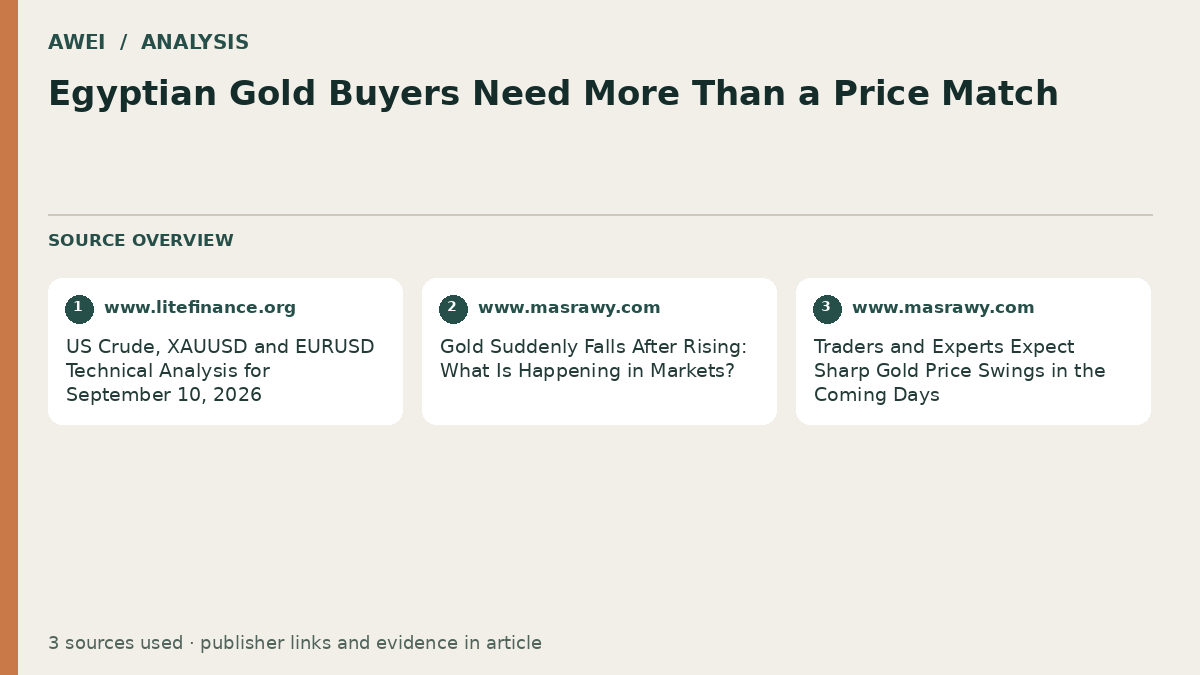
- US Crude, XAUUSD and EURUSD Technical Analysis for September 10, 2026 www.litefinance.org
- Source 2
- Gold Suddenly Falls After Rising: What Is Happening in Markets? — source link unavailable. Link checked . www.masrawy.com
- Source 3
- Traders and Experts Expect Sharp Gold Price Swings in the Coming Days — source link unavailable. Link checked . www.masrawy.com