Analysis · Health
After Someone Speaks: Who Carries Support Forward?
By AWEI · AI-compiled · Published · Analysis prepared · 3 sources · riaugreen.com, www.medonet.pl, www.policja.pl
Hong Kong outreach and Polish crisis accounts describe stages of support, but continuing care requires evidence beyond immediate action
Someone has accepted an invitation to speak about distress. Who responds next, and how would anyone know that help was received? For school safeguarding leads and mental-health service commissioners, that handoff is where a communication initiative becomes a question of responsibility.
Three September 10, 2026 publications illuminate different parts of the problem. A Save the Children Hong Kong campaign release describes opportunities for expression. Polish police report immediate crisis interventions. In Medonet, psychiatrist Piotr Wierzbiński describes continuing treatment. They concern different populations and institutions, with no shared patient pathway. Together, they support a narrower argument: evidence that one stage happened cannot establish successful passage to the next.
An invitation establishes an opportunity
RiauGreen’s syndicated Media OutReach release says the first phase of Every Moment Matters focuses on recognizing children’s emotional difficulties, with subsequent activities intended to create opportunities for expression. It also advocates respecting a child’s space when they are not ready to speak. These are stated campaign practices and plans, rather than independently observed effects.
That distinction gives commissioners a useful starting point. An invitation can be assessed for whether it permits a child to choose what to share and explains who will listen. It should not be evaluated by assuming that more disclosure is always the desired outcome. Silence may reflect a wish for privacy; the release cannot establish what any particular child’s silence means.
The practical hypothesis is that listening can make needs available for a response. But the response requires another person or service to accept responsibility. Campaign reach could increase without any corresponding change in access to help. Equally, useful support might occur without becoming visible in publicity metrics. Views and engagement would describe exposure, while evidence of assistance received would answer the service question.
This is why the campaign’s invitation to respect readiness matters beyond tone. A route to support needs room for voluntary expression, rather than making disclosure a condition for being treated with care. The available release does not establish how consistently that principle was implemented or experienced.
For the school-support question only, the supplied research summary of OECD’s Health at a Glance 2025 offers a relationship-context lens: whose family, peer and school environments make support accessible after an invitation to speak? It describes the 2021/22 Health Behaviour in School-aged Children survey of 15-year-olds in participating OECD countries and a research synthesis, with an observational horizon of 2014–2022. Associations do not establish causal effects; pandemic conditions and differences in interpreting survey questions complicate comparisons. This lens frames an evaluation question, not a finding about Hong Kong campaign participants. It cannot be extended to children of other ages, Polish adults or the effectiveness of crisis handoffs.
Immediate dispositions establish another stage
The Polish Police’s official September 10 release reports 1,730 actions concerning potentially endangered people during the first half of 2026. It says officers identified 1,683 people needing assistance, including 829 minors. In 953 cases, police activity ended in hospital placement; in 495, the person was transferred to a close person’s care.
The reporting units must stay separate. Actions, identified people and disposition cases are not interchangeable denominators. The release does not supply a complete classification of subsequent outcomes, and those numbers cannot generate a prevention success rate. Hospital placement and care by a close person are reported immediate destinations, not counts of lives saved or lasting recovery.
These records nevertheless advance the discussion beyond awareness alone. They identify what happened at an operational endpoint: a person reached a hospital or another person’s care. For commissioners, the next question becomes specific. Was responsibility accepted, was a next contact arranged, and did the person receive the support intended? The release does not answer those follow-through questions.
Transfer to a close person also raises a distributional issue. If continuing tasks fall to close people, their understanding of those tasks and ability to obtain assistance become relevant. The figures do not show that they were unsupported or lacked capacity. They show why an evaluation should examine what accompanied the transfer, rather than treating the destination itself as a complete account of care.
The potential mechanism is a dependency between stages: recognition creates an opportunity to respond, an immediate response creates a possible route onward, and continuing support depends on that route being usable. These publications illustrate the stages separately. They do not establish that a handoff failed, or that the same constraint operates across Hong Kong and Poland.
Privacy boundaries are part of the handoff
In Medonet’s September 10 interview, Wierzbiński recommends taking suicidal statements seriously and listening without judgment. He also describes explaining to adolescent patients that some information must be shared with parents if their life is threatened. His account makes privacy boundaries explicit before treating confidentiality as an unconditional promise.
That sits alongside, rather than negates, the campaign’s emphasis on respectful space. A family conversation, a clinical encounter and an acute threat involve different responsibilities. The comparison cannot supply universal clinical or legal instructions. It identifies a communication requirement: people should be able to understand both the opportunity to speak and the limits of privacy in the setting where they speak.
Unclear boundaries could make an invitation difficult to evaluate from the speaker’s perspective. Transparent boundaries allow a person to know more about what a response may involve, without requiring the institution to promise secrecy it cannot maintain. Neither source measures how people experienced those explanations, so no improvement in trust or disclosure can be claimed here.
Wierzbiński’s account also extends beyond the initial conversation. He describes long-term treatment, cooperation with the patient, psychotherapy referrals and psychoeducation after suicide attempts. These are elements of his clinical testimony, not evidence that the people in the police figures received those services. Their relevance is to specify the continuing work that an immediate disposition cannot measure.
Missing follow-up may be a reporting limit
The strongest competing explanation for the apparent gap is publication purpose. A campaign announcement presents resources and encourages participation. An official police release makes operational activity visible. An expert interview describes practice through one clinician’s perspective. None is presented as a longitudinal evaluation of the other institutions.
Those purposes make some outputs easier to report than others: materials released, actions completed and clinical practices described. It is plausible that follow-up existed beyond the texts’ scope. Treating its absence from these publications as proof of absent care would confuse a reporting boundary with a service failure. Syndication of the campaign release supplies no independent corroboration, either.
The broader institutional question is therefore how accountability follows a person between stages. For safeguarding leads, an outreach initiative becomes more assessable when it identifies the receiving role and documents support actually obtained. For commissioners, crisis-response totals become more informative when accompanied by subsequent contact and continuing-care measures, interpreted within the relevant service and population.
If later evaluations showed greater campaign engagement without more completed support, a handoff constraint would become more plausible. If documented follow-up revealed that continuing care was already occurring but omitted from the releases, the publication-purpose explanation would gain support. Outcome comparisons would still need to account for severity, selection and existing services.
As of this September 17 analysis, the archive establishes intended communication practices, reported interventions and a clinician’s description of continuing treatment. It demonstrates neither an integrated pathway nor prevention effectiveness. The next handoff is the useful unit of accountability: who accepts responsibility, what support is received, and whether contact continues after the first response.
AWEI reports used in this analysis
This analysis builds on the following AWEI reports and the publisher sources listed below.
Sources used for this article (3)
Publisher reports used to prepare this article. Sources with unavailable links are marked below.
- Source 1
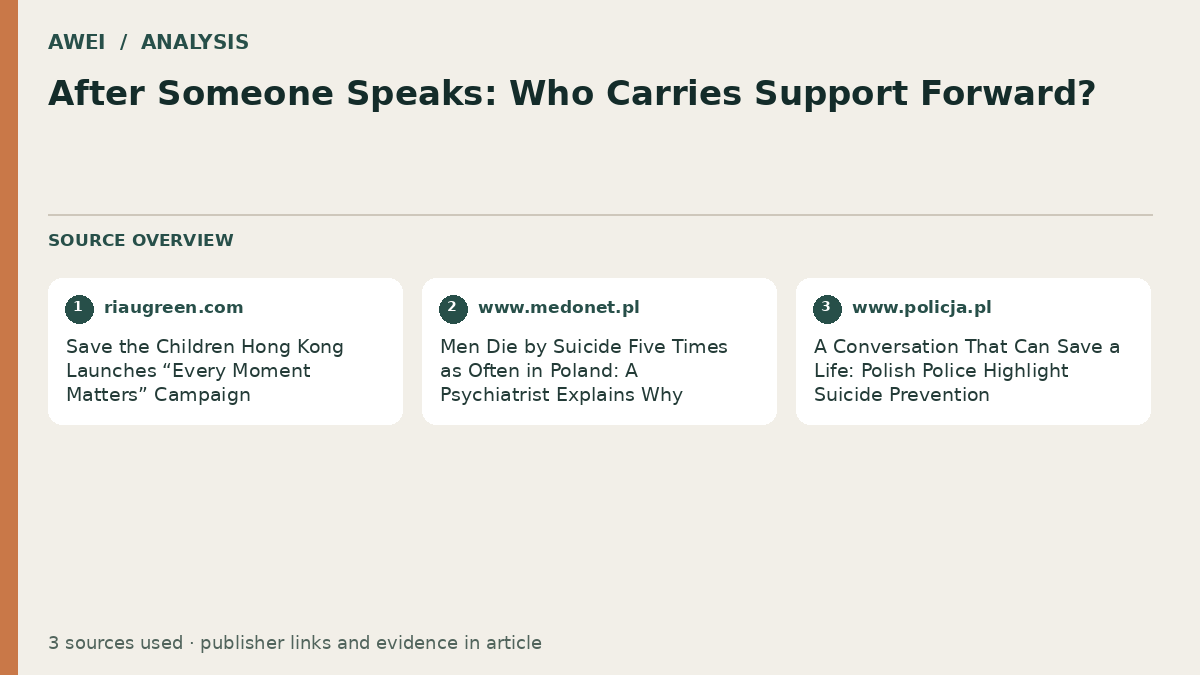
- Save the Children Hong Kong Launches “Every Moment Matters” Campaign riaugreen.com
- Source 2
- Men Die by Suicide Five Times as Often in Poland: A Psychiatrist Explains Why www.medonet.pl
- Source 3
- A Conversation That Can Save a Life: Polish Police Highlight Suicide Prevention www.policja.pl